
Memory improves continuity only when every retained item has a purpose, owner, lifetime and correction path.
An autonomous team needs continuity. It should know what has already been attempted, recover useful preferences and resume a case without asking a person to repeat the entire history. The easiest response is to retain more conversations. It is also the fastest way to create a shadow database filled with unverified facts, sensitive data and decisions that have expired.
The useful question is not how much an agent can remember. It is which information deserves to survive the current task, under whose authority, and with what correction mechanism. A recent exchange may clarify a request without becoming a durable truth. A preference may be reusable without carrying the authority of a contract. A validated delivery address, invoice status or binding approval belongs in the business application that controls its version and accountable owner.
For Atlensia, that choice belongs in the operating layer. A model may extract or propose a memory, but it should not decide alone that the item becomes permanent. The operating layer needs to separate working context, long-term memory and the system of record, then give each layer an identity boundary, purpose, lifetime and record of use.
Three layers carry three different responsibilities
Working context contains what the autonomous team needs for the task in progress: its mandate, recent messages, tool results, completed steps and applicable constraints. Its value comes from proximity to the action. It can be summarized or discarded when the work closes because it is not meant to become general knowledge about a person or organization.
Long-term memory contains items that may improve future sessions: an explicitly stated preference, a validated lesson about a recurring process, a summary of an ongoing case or a local operating rule that has not yet been structured elsewhere. It can be valuable, but it remains a derived representation. A model may have extracted it, a service may have consolidated it across exchanges, or a similarity search may retrieve it. Its provenance, scope and confidence therefore remain material.
The system of record carries facts that produce a business or legal effect. A CRM owns opportunity status, an ERP owns order state, a human resources system owns contractual data, and a support platform owns the official case state. Copying those facts into agent memory may accelerate an answer, but the copy must never become the authority for deciding whether the fact remains true.
| Layer | Purpose | Typical lifetime | Authority | Example |
|---|---|---|---|---|
| Working context | Complete the task in progress | Turn, session or active case | Mandate and execution state | Intermediate research result |
| Long-term memory | Improve continuity across sessions | Limited, revisable and revocable | Memory policy and provenance | Confirmed output preference |
| System of record | Hold the official business fact | Business and legal retention rules | Owning application and designated roles | Validated contract status |
This distinction prevents two opposite failures. Without long-term memory, the team repeats work and loses useful adjustments. Without a boundary around the system of record, it can act on an outdated summary while believing it has consulted operational truth.
The first diagram shows how the layers cooperate without becoming interchangeable.
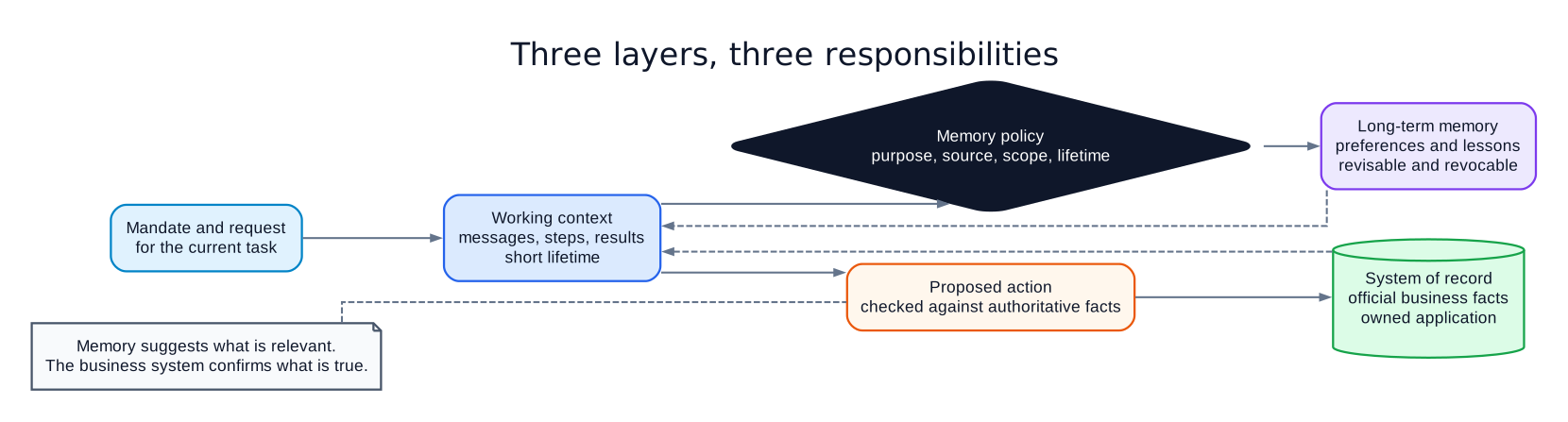
Atlensia diagram: working context supports the task, long-term memory supports continuity, and the business system retains facts that commit the enterprise.
The flow is not symmetrical. The business system can supply a verified fact to working context. A conversation can propose an item for long-term memory. A model-generated proposal should not directly change the system of record or enter shared memory without a policy decision about its scope.
Memory products automate extraction, not accountability
Recent platforms make memory easier to integrate, but their mechanisms reinforce the need for explicit policy. Amazon Bedrock AgentCore Memory documentation separates short-term memory made of session events from long-term memory that can extract facts, preferences, summaries or episodes through configurable strategies. AWS also supports namespaces tied to actors and sessions, with access restrictions through IAM.
Google Agent Platform Memory Bank documentation describes extracting memories from conversations and consolidating them by creating, updating or deleting stored items. Memory topics define what is considered meaningful to retain. Google also cautions that excluding sensitive or personal data is not infallible. That qualification matters: a memory extractor reduces implementation work, but it does not replace data classification or a retention decision.
These services should not be reduced to a generic feature checklist. AWS exposes strategies, namespaces, metadata and deletion operations. Google emphasizes extraction topics, scopes and contradiction consolidation. In both cases, memory quality depends on decisions made outside the model: which sources are admissible, which actor owns an item, how long it remains valid, and what event requires revision.
An enterprise should therefore evaluate a memory product by its ability to enforce policy, not only by the fluency of a demonstration. Conversational continuity is visible immediately. Scope errors, conflicting memories and incomplete deletion emerge later, especially when several roles or autonomous teams share infrastructure.
Facts that commit the enterprise stay with their owning application
Agent memory becomes particularly dangerous when it looks enough like a business database to be trusted but lacks the database's controls. A summary may claim that a customer accepted a commercial term. If the term is absent from the CRM or approved agreement, it remains contextual evidence. Using it to issue an offer silently turns a hypothesis into a commitment.
The decisive criterion is the effect of an incorrect value. If an error can change a payment, obligation, access right, regulatory status, contractual relationship or binding external communication, the workflow needs to read the owning system at action time. Memory may retain a pointer, identifier and explanation of relevance. It should not replace a fresh read of the authoritative fact.
This rule also prevents correction conflicts. When an address changes, a person should know where to update it. If the CRM, vector store, session summary and agent profile each carry a version, correction becomes a search for copies. A reliable architecture names one authority and treats every other representation as temporary or derived.
For an operating layer, the separation yields a practical rule: memory suggests what may be relevant to retrieve, while the business integration confirms what is true now. The model may formulate a query or explain a discrepancy. It does not silently choose whichever copy best supports its plan.
The retention decision comes before the write
Storing first and filtering later reverses the order of governance. Sensitive data may already have been indexed, summarized or propagated into shared memory before a deletion request arrives. The OWASP Top 10 for Agentic Applications 2026 describes memory and context poisoning as corruption of retained or retrievable information that later affects reasoning, planning or tool use. The effect can persist across sessions and move between agents.
The write gate needs four answers. Does the information have a specific future purpose? Is its source admissible and identifiable? Can its validity period be determined? Does a person or system have the right to correct, revoke or delete it? If any answer is missing, durable retention is premature.
The following decision tree turns those questions into architecture choices.
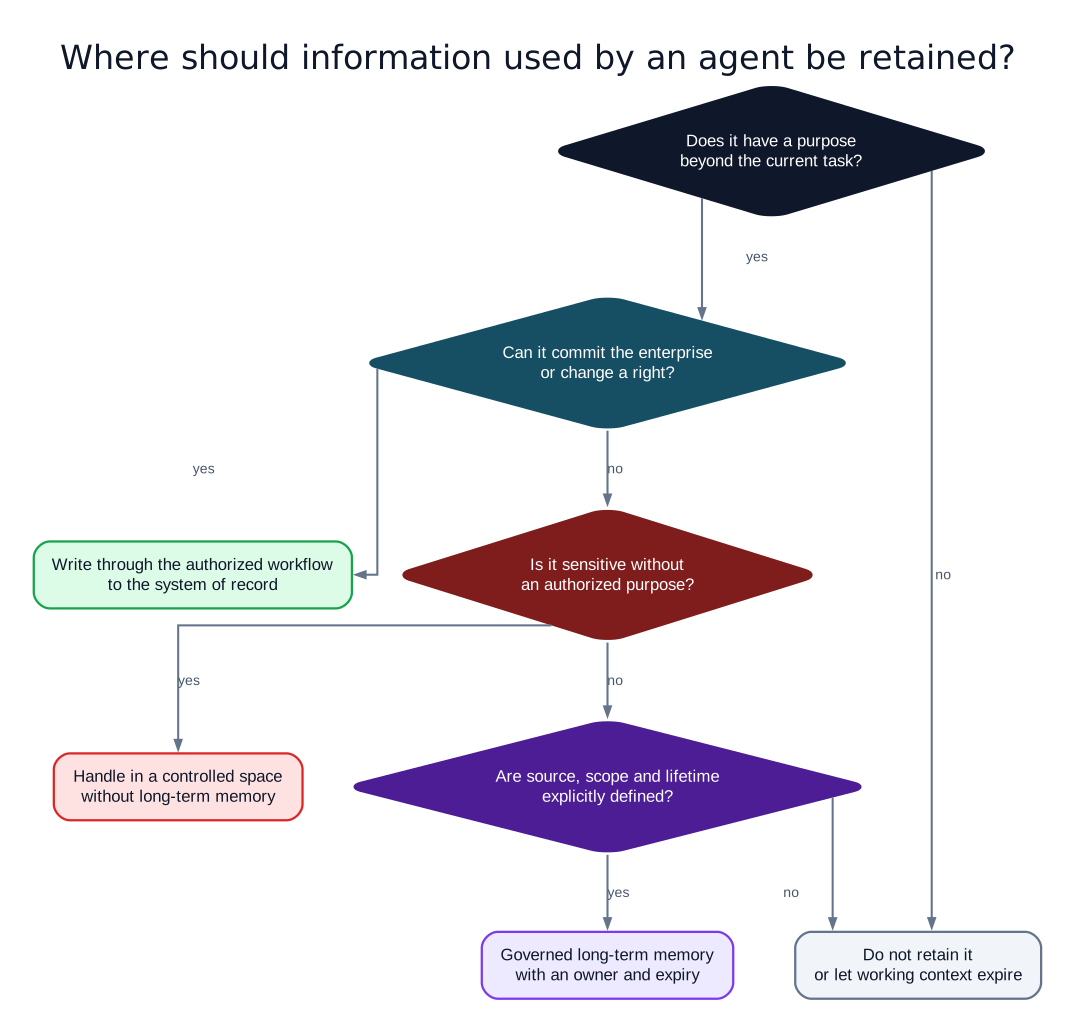
Atlensia diagram: the nature of a fact, its validity, sensitivity and business effect determine its destination, not the technical ability to remember it.
The tree does not divide every item into useful or forbidden. It selects the appropriate regime. An intermediate step with no future value disappears with context. A stable and consented preference may enter long-term memory with an expiry. A binding fact is written through an authorized workflow to the business system. Sensitive data without an admissible purpose is not retained.
Governed memory has an observable lifecycle
Creation is only the first event. A long-term memory needs to be retrievable with its provenance, comparable with new information, correctable and deletable. AWS documents separate operations for deleting short-term events and long-term memory records. Its documentation warns that deleting a source event does not automatically delete structured information derived from that event. An erasure procedure must therefore follow derivations, not only the original message.
Privacy rules reinforce this reasoning without prescribing a particular agent architecture. Article 5 of the GDPR establishes principles including purpose limitation, data minimization and storage limitation. Applying them to agent memory requires visibility into why an item exists, which actions use it and when it must be reviewed or removed.
| Lifecycle moment | Required control | Expected evidence |
|---|---|---|
| Proposal | Admissible source, purpose and category | Source event and extraction reason |
| Write | Scope, owner, sensitivity and lifetime | Policy decision and expiry date |
| Retrieval | Identity, task and relevance | Query, namespace and returned records |
| Use | Confirmation of binding facts at source | Current read from the system of record |
| Correction | Verified new information and conflict handling | Version history and accountable owner |
| Deletion | Removal of the memory and its derivations | Deleted identifiers and operation result |
A relevance score is not proof of truth. Similarity indicates that a memory is close to a query, not that it is accurate, authorized or still valid. Retrieval should be filtered by identity, role, organization, memory type and time window before content enters model context.
The revealing test is a bad memory
A pilot should do more than show that an agent remembers a correct preference. It needs to observe what happens when an authoritative source contradicts memory, another user attempts retrieval, an item expires, or a malicious document tries to establish a persistent instruction. Those tests reveal whether memory is a governed service or an accumulation of text.
Consider an illustrative customer support workflow. A user asks to receive technical responses as PDF files. The preference may be retained if it is assigned to the correct account, is not sensitive and can be revoked easily. The contractual service level, however, must be read from the CRM or support platform before making a commitment. A sentence in an attachment asking the team to ignore that rule belongs in neither durable memory nor the system of record.
The test set should cover actor isolation, contradiction, expiration, deletion and an attempted poisoning event. For each case, the team retains the source, memory decision, retrieved records and observed effect. The NIST AI RMF Generative AI Profile addresses privacy, information integrity and component integration risks. Memory cannot be assessed independently from the tools and decisions it influences.
Conclusion
Longer memory is not automatically better memory. Working context serves the present task. Long-term memory provides continuity under rules for scope, lifetime and correction. The business system holds official facts that commit the enterprise. Merging these responsibilities creates a shadow database whose errors can outlive the conversation that produced them.
The practical next step is to select one real workflow and inventory ten information items it handles. For each item, decide whether it should disappear after the task, remain available across sessions or be confirmed in a system of record. Add an owner, lifetime and correction test. The result is an actionable memory policy that can guide product selection instead of being dictated by it.
Primary sources and references
- Amazon Bedrock AgentCore Memory
- AWS, memory organization and namespaces
- AWS, deleting short-term events
- Google Agent Platform, generating and consolidating memories
- OWASP Top 10 for Agentic Applications 2026
- NIST AI 600-1, Generative AI Profile
- General Data Protection Regulation, Article 5
- Atlensia platform and operating layer