
Choosing a trigger mechanism means defining a consistency contract, not merely a latency target.
The right trigger is not necessarily the fastest one. For an autonomous team connected to a CRM, Microsoft 365, or an operational system, the real test is whether every relevant work item will be detected, handled under the right authority, and reconciled with the source of truth. A webhook can reduce latency, but it does not guarantee completeness or grant permission to act.
For most enterprise workflows, the strongest starting point is a hybrid design. A webhook or event stream provides the fast signal, while a scheduled state query, cursor, or delta feed catches interruptions and confirms convergence. Polling alone remains a sound option when the source has no dependable event capability, volume is low, or a delay of several minutes is acceptable. A durable event bus earns its place when multiple consumers, bursty workloads, or replay requirements justify the additional operating model.
The channel choice is a consistency contract
Treating webhooks, polling, and streams as three transport preferences encourages a latency-only decision. The channel also determines what the autonomous team knows about a change, how it proves that the change was handled, and what happens after an outage. A notification may contain only a reference, arrive more than once, arrive after a newer event, or fail to reach the consumer.
The contract should therefore define the business work item rather than merely the received message. For a sales process, that unit might be a particular version of an opportunity that needs qualification. For a shared inbox, it might be a message identified with its folder, sender, and current status. The autonomous team handles that unit under an explicit identity and mandate, then verifies the effect in the system of record.
This framing separates three commitments. Detection asks whether something changed, qualification asks whether that change requires work, and execution asks whether this team is allowed to produce this effect now. Collapsing those commitments turns a transport notification into an implicit authorization decision.
Webhooks, polling, and streams solve different problems
A webhook is an HTTP call initiated by the source when an event occurs. Polling is a query initiated by the consumer, preferably an incremental one using a cursor or delta token. An event stream places a durable log or broker between producers and consumers. The following table compares the mechanisms using criteria that materially change an enterprise architecture decision.
| Mechanism | Primary advantage | Structural limitation | Required control | Good starting context |
|---|---|---|---|---|
| Direct webhook | Low latency and focused implementation | Public endpoint, outages, and redelivery | Signature, durable inbox, and deduplication | One source, one consumer, moderate volume |
| Full polling | Conceptual simplicity | Cost, quotas, and blind windows | Reference timestamp and stable pagination | Small dataset, simple API, tolerable delay |
| Delta polling | Recovery from a known state | Depends on provider cursor semantics | Cursor retention and expiry handling | Source with a dependable change log |
| Stream or broker | Burst absorption, fan-out, and replay | Additional platform, schemas, and operations | Retention, partitioning, DLQ, and observability | Several consumers or variable high volume |
| Push plus delta | Fast response with a catch-up path | Two paths to test and reconcile | Shared business identifier and convergence rule | Important workflow exposed to interruptions |
| Scheduled trigger | Predictable and governable cadence | Delayed reaction | Business window, locking, and failed-run recovery | Reports, controls, or batch processing |
The table does not identify a universal winner. It shows that the useful guarantee comes from the combination of channel, persistence, recovery, and business logic. A webhook with no journal can be less dependable than a carefully implemented delta query, while a broker with a non-idempotent consumer cannot prevent duplicate business effects.
A webhook is an alert, not a work queue
GitHub's webhook guidance makes this separation concrete. GitHub recommends subscribing only to required events, using a secret, keeping HTTPS verification enabled, responding within the expected window, redelivering missed deliveries, and using the delivery identifier to resist replay attacks. The endpoint should acknowledge promptly, while longer processing moves to an asynchronous queue.
Microsoft Graph applies the same principle with provider-specific timing. Its documentation current in September 2026 considers a change notification delivered when the endpoint returns a 2xx response within three seconds. If processing cannot finish in that window, Microsoft recommends validating and persisting the notification in a queue and returning 202 Accepted. The HTTP response therefore means that the signal is durably accepted, not that the business task is complete.
The ingress boundary should do very little. It verifies origin, validates a minimal schema, assigns or extracts a stable identifier, persists the signal, and responds. It should not call a model, load several systems, or make a sensitive decision before acknowledgment. This separation protects delivery when an autonomous team, connector, or model becomes slow.
The webhook payload is not necessarily the source of truth. After verification, the consumer can retrieve the resource using its own limited credentials and obtain the current state. That read reduces trust in pushed content and applies the same access policy used for ordinary API calls.
Polling is the recovery plane
Polling is often dismissed as an outdated integration pattern, yet it remains a strong control mechanism. A delta query or cursor can ask which changes have not been reconciled since a known checkpoint. That path detects dropped notifications, expired subscriptions, and business effects that failed to converge.
Microsoft Graph explicitly documents the lifecycle events reauthorizationRequired, subscriptionRemoved, and missed. After a subscription is removed or notifications are missed, the application must repair or recreate the subscription and then synchronize the underlying data, for example with a delta query. Webhook availability therefore does not remove the need for a recovery strategy.
Reliable polling does not have to scan an entire dataset. It retains a cursor, handles pagination deterministically, narrows the scope, and records the point through which the source state is confirmed. If the provider invalidates the cursor, the system falls back to a controlled resynchronization instead of guessing where to resume.
Its cost must remain visible. Polling too frequently consumes quota without improving a business decision, while polling too slowly extends the period during which work remains unknown. The right interval follows the maximum acceptable detection gap, business urgency, and source capacity rather than a standard schedule copied across integrations.
A durable stream is justified by replay and fan-out
A broker or event log becomes valuable when the signal must outlive its consumers, feed several functions, or be replayed after a correction. It absorbs bursts and decouples producer speed from the processing rate of autonomous teams. These capabilities introduce an operating burden: platform management, schema contracts, retention rules, partitioning, monitoring, and a process for poison messages.
Google Cloud Pub/Sub documents at-least-once delivery as the default and notes that messages may be redelivered or arrive out of order. Even exactly-once capabilities have a defined scope and do not eliminate every possible publishing duplicate. The consumer must remain idempotent, meaning that receiving the same logical work item more than once produces the same final state.
AWS EventBridge illustrates another explicit responsibility. The service retries failed target deliveries according to a configurable policy and recommends a dead-letter queue for events that exhaust those attempts. A DLQ is not self-operating, however. It requires an owner, a response time, and a tested replay procedure.
CloudEvents defines common metadata for describing events across platforms. That envelope improves routing and portability, but it does not define the business meaning on its own. An organization must still explain what customer.updated means, which version wins, which fields are sensitive, and which downstream effects are permitted.
Every signal moves through a state machine
The state machine below makes the boundary between transport and authority visible. Webhooks, streams, and polling converge on the same durable inbox. The signal is then verified, qualified, deduplicated, and evaluated against policy before an autonomous team can produce an effect.
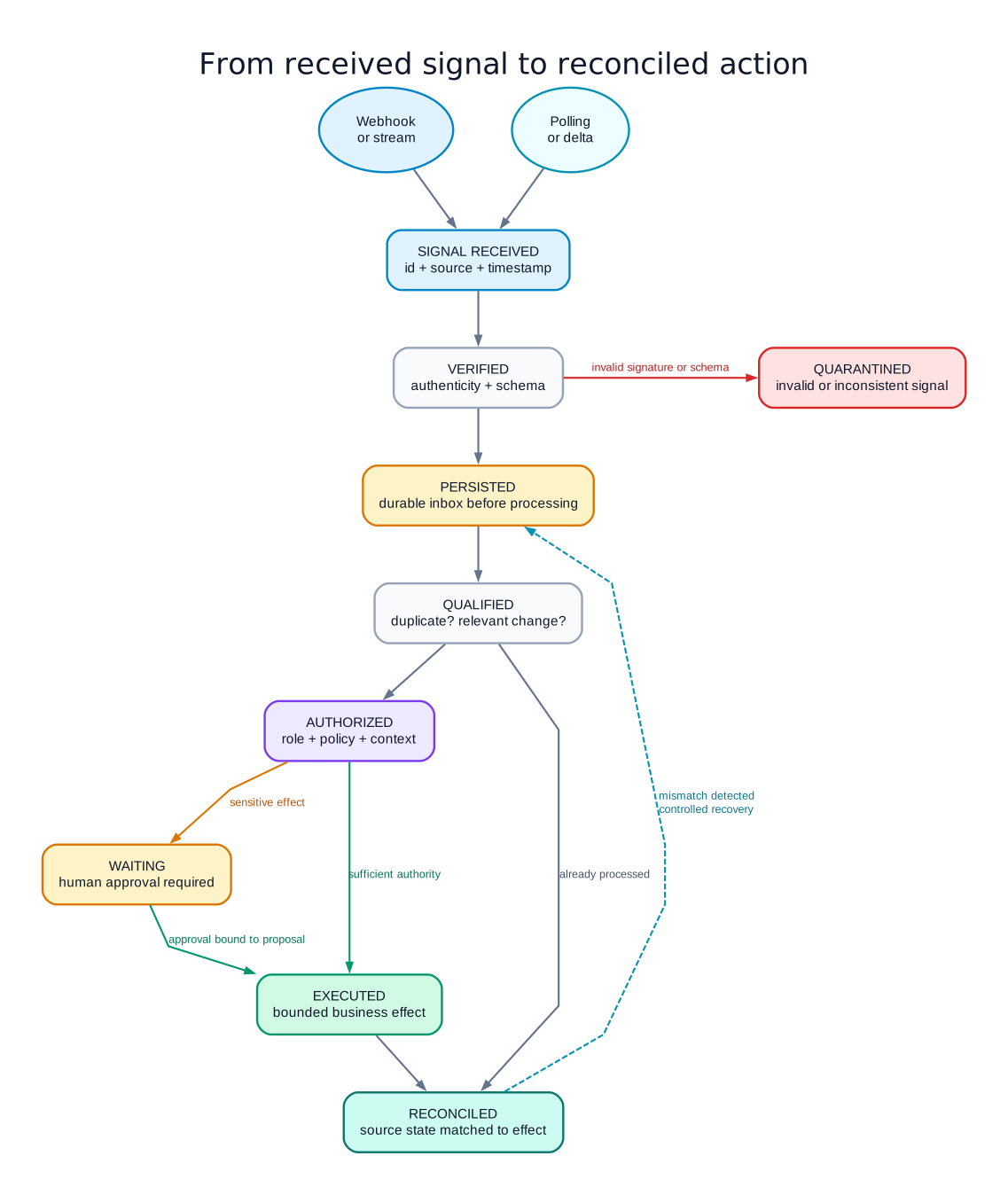
Atlensia diagram: the channel detects a change, while the Operating Layer qualifies, authorizes and reconciles every action before closing the work item.
The first critical transition is persistence before processing. If acknowledgment is sent before the signal is durable, a failure can create silent loss. If acknowledgment waits for the full reasoning process, the source may mark delivery as failed and generate repeated attempts.
The second critical transition is reconciliation after the effect. The team does not close the work item because a tool returned a successful response; it reads the reference object again or verifies a business invariant. A mismatch routes the item into controlled recovery instead of issuing a second blind action.
This model complements Atlensia's guide to connecting an autonomous team through an API, workflow, or MCP. The protocol used to invoke a tool does not decide how work is detected, persisted, and recovered. Both decisions still need to share business identifiers, policies, and traces.
Deduplication and ordering are business concerns
A delivery identifier can recognize a repeated transport attempt, but it may not cover a functional duplicate. Two different messages can announce the same modification, and a republished event can carry a new identifier. The idempotency key should represent business intent, such as the object, version, and expected effect.
Idempotency does not mean ignoring every repetition. It means that repeating processing does not create a second payment, second notification, or inconsistent mutation. The consumer retains the result associated with the key, checks current state, and returns a consistent outcome without repeating the effect.
Ordering needs the same discipline. A case.closed event can reach a consumer before case.updated because of partitions, retries, or network behavior. Rather than assuming global order, the team compares a source version, sequence number, or source-issued timestamp and refuses to move the business object backward.
These controls require failure scenarios rather than happy-path tests alone. Stop the consumer after persistence, after the tool call, and before final acknowledgment; deliver the same signal again; reverse two versions; expire a cursor; then confirm that the business state converges without duplicate effects.
Detection never grants authority
An authentic notification proves, at most, that a known source emitted a signal. It does not prove that the content is accurate, the object belongs to the team's scope, or the proposed action still complies with policy. The Operating Layer must rebuild authorization context at execution time.
That decision combines team identity, active role, resource, effect type, data sensitivity, and required approvals. Human approval should bind to a specific proposal and version. If the object changes after approval, the decision must be evaluated again. A webhook can never bypass this gate.
This separation is especially important for Microsoft 365. Notifications indicate that a resource changed, while the credentials used to retrieve or modify that resource should remain narrowly scoped. Atlensia's article on connecting an autonomous team to Microsoft 365 without widening risk explains the identity and permission model that should accompany the trigger channel.
Measure the full chain, not the receipt time
Time from source event to notification receipt is useful but incomplete. A team can receive work quickly and let it age in a queue, or acknowledge a message without producing the intended effect. Measurement must follow the business work item from source to reconciliation.
An operational view should connect detection lag, backlog age, duplicate rate, validation failures, retries, quarantined items, human waits, and reconciliation mismatches. It should also separate channel latency from decision latency and effect latency. That decomposition shows which part of the system actually needs attention.
Service objectives should describe a business consequence. “Every priority request is detected and assigned within the agreed window” is more useful than “the webhook responds within three seconds.” The technical target remains necessary, but it is only one condition of the outcome.
Recovery paths also need exercising. A DLQ that nobody reads, a cursor that has never been restored, or a resynchronization process that has never run provides theoretical assurance only. Controlled drills verify ownership, recovery time, replay safety, and the evidence retained for review.
Choose by scenario, then design convergence
For one SaaS application, moderate volume, and a seconds-level response objective, a signed webhook into a durable inbox with scheduled reconciliation is usually the strongest starting point. It is understandable, limits infrastructure, and establishes a clear catch-up path.
When the source offers no dependable webhook, delta polling is better than fragile pretend real time. The system adjusts frequency to urgency, protects its cursor, and monitors detection lag. Full scans make sense only when dataset size and provider quotas keep their cost acceptable.
When several autonomous teams consume the same events, bursts exceed a direct endpoint's capacity, or replay is a formal requirement, a durable stream becomes justified. The decision must then include partitioning, retention, schemas, deduplication, and DLQ operations. A broker should not be added merely to modernize an architecture diagram.
Some work should not trigger on every change at all. A daily close, periodic control, or consolidation process can remain scheduled because cadence is part of the business rule. Good autonomy includes knowing when not to react.
Conclusion
Choosing among webhooks, polling, and event streams means deciding how work will be detected, retained, recovered, and proven. Push provides speed, state-based polling provides catch-up, and streams provide durability, fan-out, and replay when scale warrants them. None of these channels replaces deduplication, idempotency, access policy, or reconciliation.
The next step is to select one workflow and write its consistency contract: maximum tolerable loss window, target delay, business identifier, source of truth, recovery rules, and effects that require approval. That contract lets the team choose the simplest architecture that protects the outcome, then test interruptions before connecting autonomous work to live operations.
Primary sources and references
Microsoft Graph, Receive change notifications through webhooks, documentation updated in 2026
Microsoft Graph, Reduce missing subscriptions and change notifications, documentation updated in 2026
GitHub Docs, Best practices for using webhooks, documentation current in September 2026
Google Cloud Pub/Sub, Subscription overview, updated August 26, 2026
Amazon EventBridge, How EventBridge retries delivering events, documentation current in September 2026
CloudEvents, common event data specification, version 1.0.2
Atlensia, platform for autonomous enterprise teams, 2026