
Reliable sales autonomy separates research, recommendation, communication and commitment instead of reducing qualification to one score.
An autonomous team can prepare a lead qualification decision, but it should not convert every lead into an opportunity or permanently reject a prospect on its own. Its first job is to make the record decidable: verify identity, detect duplicates, gather approved evidence, apply explicit criteria, and expose uncertainty. Conversion, outreach, and commercial commitment then use separate thresholds, with human approval when an effect is difficult to reverse.
This separation avoids two opposite failures. An overly cautious system produces a summary that the seller must recreate, while an overly aggressive one creates duplicate records, personalizes messages from weak data, or closes a lead because of an opaque score. Good design does not maximize the percentage of automated decisions. It finds the level of autonomy that improves pipeline quality without weakening accountability.
Qualification is a market judgment, not a field update
In a CRM, qualification does more than change a status. It asserts that a person or organization fits a target, that a need appears credible enough, and that additional sales effort is justified. That decision changes seller priorities, forecasting inputs, and sometimes the creation of an account, contact, or opportunity.
Microsoft's Dynamics 365 Sales documentation, updated in 2026, describes qualification as validating a genuine sales opportunity, associating it with an account and contact, and potentially creating an opportunity record. The system also retains an audit trail for disqualified leads. This behavior shows why status is not merely a label: it creates objects, ownership, and history in the sales system.
An autonomous team should not infer the definition of a good lead from historical examples alone. Past data reflects territories, data-entry habits, incentives, and organizational bias. Before selecting a model, the business must define what makes a record eligible, prioritized, incomplete, or out of scope, including the exceptions that require a seller's judgment.
Atlensia recommends separating eligibility, priority, and action. Eligibility checks minimum conditions and prohibitions. Priority orders already eligible work according to estimated value and urgency. Action commits the organization to a specific step, such as converting, contacting, asking for information, or closing. One score should not perform all three jobs.
The qualification contract comes before the agent
The contract starts with a precise object. Depending on the process, it may be an inbound form, a partner referral, an event registration, or an account identified by a seller. Each source has a different quality, purpose, and permission context. Combining them without provenance removes conditions the workflow still needs.
Criteria should be observable. “Interesting company” cannot be tested, while “served industry, supported region, compatible size, and confirmed need” can be connected to fields and evidence. Unknown information remains unknown. The team asks for clarification or lowers confidence rather than inventing the most likely answer.
The contract also separates hard rules from signals. A direct-marketing objection, unsupported territory, or excluded customer type is a rule. Recent growth, hiring, or a vendor change may raise priority, but it does not prove purchase intent. This hierarchy prevents the model from offsetting a prohibition with several attractive signals.
Every recommendation also has an expiration horizon. Budgets, roles, projects, and contact identities change over time. The record stores date, sources, criteria version, and confidence so that the seller knows when to verify the recommendation again.
Identity and duplicate control precede enrichment
An autonomous team that enriches the wrong account creates an impressive but unusable file. The first task is identity resolution: distinguish legal entity, location, domain, brand, contact, and role, then search for existing CRM records. An uncertain match should be proposed, never silently merged.
Salesforce documents that lead conversion can create an account, contact, and optionally an opportunity. Duplicate and matching rules determine whether existing records are suggested and whether creation is allowed, warned, or blocked. Salesforce also advises users to verify the resulting account and contact data after conversion. Because this behavior depends on configuration, an autonomous team must read the actual CRM policy rather than assume a universal conversion path.
Deduplication combines evidence without treating every identifier as equal. A corporate domain may be strong evidence, while an abbreviated trading name remains ambiguous. A personal email address can identify a person without proving a current employer. When indicators conflict, the correct output is “match requires confirmation” with candidate records, not a probabilistic merge.
The cost of duplication extends beyond CRM hygiene. Two sequences may contact the same person, two sellers may believe they own the account, and attribution metrics may diverge. The Operating Layer should apply a business key, an idempotency lock, and a merge policy before any creation or conversion.
Enrichment should produce evidence, not a biography
The autonomous team should collect only data that supports a defined criterion or a legitimate next action. The EU General Data Protection Regulation establishes principles including purpose limitation, data minimization, and accuracy for personal data. In a European context, organizations must also honor the right to object to direct marketing under Article 21 and propagate that signal into the relevant communication channels.
This requirement changes the research prompt. Instead of asking the team to find everything about a prospect, the workflow asks for recent evidence that the organization belongs to a supported segment or confirmation that a contact still holds a relevant role. Each fact retains its URL, date, scope, and a short quotation or structured extract when needed.
An inference remains labeled as an inference. Hiring specialists may indicate a project, but it proves neither budget nor buying intent. The autonomous team can use that signal to propose a question, not to populate a “confirmed need” field automatically.
NIST defines confabulation as confidently presented false or erroneous content and links information integrity to distinguishing facts, opinions, and inference, acknowledging uncertainty, and retaining a chain of evidence. That distinction applies directly to sales research. A fluent summary without provenance should not become authoritative CRM data.
Responsibility changes at every stage
The following matrix does not allocate work according to what a model can technically generate. It assigns responsibility according to the consequence of error. The autonomous team prepares the decision, the seller handles ambiguity and commitments, and the Operating Layer applies cross-cutting controls.
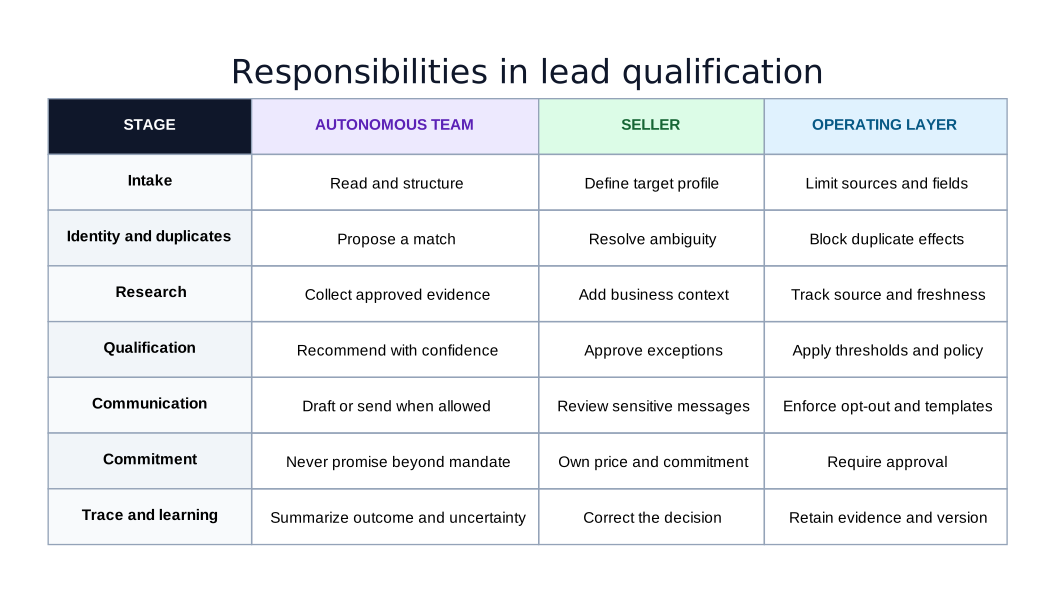
Atlensia diagram: the autonomous team prepares and documents qualification, the seller owns exceptions and commitments, and the Operating Layer enforces policy and retains evidence.
The matrix prevents “human in the loop” from becoming one undifferentiated checkpoint. A seller does not need to confirm every structured field when deterministic controls make the change reversible. The seller enters where context, relationship, or commitment changes the decision, and each correction becomes material for future evaluation.
The Operating Layer does not replace the CRM or the seller. It connects identity, policy, approved sources, thresholds, approvals, and traces so that each stage has an owner. A work item can move between actors without losing the reason for its current status.
Set autonomy separately for every action
One lead can move through several autonomy levels. The team may deduplicate automatically, recommend a qualification, prepare a reviewed message, and remain prohibited from offering a discount. The table below translates that principle into design decisions.
| Action | Recommended starting level | Required evidence | Escalation condition |
|---|---|---|---|
| Structure an inbound form | Automatic when schema is stable | Original value and target field | Unknown format or unexpected sensitive data |
| Search for duplicates | Automatic recommendation | Candidate records and match indicators | Several plausible matches |
| Enrich one criterion | Automatic on approved sources | Source, date, and extracted fact | Contradictory or stale evidence |
| Determine eligibility | Automatic for deterministic rules | Passed rules and blocking conditions | Missing data or business exception |
| Recommend priority | Assisted with visible confidence | Signals, weighting, and uncertainty | Strategic account or near-threshold result |
| Convert to opportunity | Automatic only in a proven scope | Identity, criteria, and no duplicate | High forecast impact or ambiguity |
| Prepare outreach | Automatic as a controlled draft | Facts used and approved template | Sensitive claim or risky personalization |
| Send a message | Limited to pre-approved scenarios | Allowed channel, opt-out check, and version | Sensitive first contact, exception, or doubt |
| Offer price or commitment | Human by default | Commercial context and authority | Always according to approval policy |
The starting position is intentionally asymmetric. A formatting error is easy to correct, while contacting the wrong person, making an unauthorized promise, or rejecting a valid opportunity can damage relationships and reporting. Autonomy increases after evaluation and production feedback, not because the agent delivered a few persuasive demonstrations.
A recommendation must explain uncertainty
A useful output is richer than “qualified” or “not qualified.” It presents satisfied criteria, missing information, evidence, contradictions, and the least risky next action. This structure lets a seller correct one element without repeating the entire research process.
Confidence should reflect evidence quality rather than the model's writing style. A record can have high identity confidence and low confidence in purchase need. Keeping those dimensions separate prevents technical certainty about the company from masking the absence of a commercial signal.
Near-threshold cases deserve particular attention. A small data or policy change can reverse the recommendation, so these cases should trigger review or a clarification request. The autonomous team can state what needs to be learned before a decision is possible, which is more useful than a rounded score that implies false precision.
Disqualification also requires extra care. A lead that is out of scope today may become relevant later, and missing data is not negative evidence. When the CRM supports it, retaining a reason, supporting evidence, and a reactivation path preserves history without inflating the active pipeline.
Communication is a separate control gate
Drafting and sending are different capabilities. A draft can be evaluated offline, reviewed, and corrected. Sending creates an external interaction, uses a regulated or governed channel, and represents the company. Moving between the two requires its own policy.
An approved message uses verified facts, follows permitted templates, and does not reveal inappropriate data collection. It invents no relationship, customer example, or outcome. Statements about price, timing, capability, or compliance require the authority defined by the organization.
The workflow checks communication preferences and objections before every send, not only when the lead first enters the system. Status can change between preparation and execution. When human approval is required, it binds to the exact message version so that later regeneration cannot inherit an outdated approval.
For some inbound scenarios, a tightly bounded automatic response may be appropriate, such as acknowledging receipt and asking for one missing fact without making a promise. For a strategic account, sensitive sector, or highly personalized outbound first contact, the seller should retain the decision and timing of the message.
The CRM remains the system of record
The autonomous team should not maintain a shadow pipeline in model memory or conversations. The CRM retains authoritative identity, status, ownership, activity, and history. Generated notes enter as structured proposals with provenance rather than isolated truths.
Every write uses a limited service identity and an idempotent operation. Before conversion, the workflow rereads the record, confirms that the lead is still open, and checks whether a concurrent opportunity or merge changed the context. After the write, it retrieves the resulting objects and reconciles them with the original intent.
The trace should answer a sales question, not only a technical one. It connects the intake, sources, criteria version, recommendation, approval, CRM action, and result. This evidence shows why the pipeline changed and distinguishes a research failure from a bad policy or faulty execution.
This discipline extends Atlensia's approach to AI agent memory and systems of record. Working context helps the team reason, but the system of record retains durable business state. A pipeline should never have to be reconstructed from a conversation summary.
Measure pipeline outcomes and corrections
High processed-lead volume does not prove better qualification. It may show faster triage while duplicate rates, false rejection, or messaging quality deteriorate. Measurement must combine productivity, decision quality, and commercial consequences.
Before deployment, the organization builds a representative set of records with expert decisions, incomplete cases, duplicates, and exceptions. It compares recommendations, inspects evidence, and measures false positives and false negatives separately. Their costs are not symmetric: qualifying a poor fit consumes seller capacity, while rejecting a strong fit may remove an opportunity entirely.
In production, seller corrections are signals, not automatic training truth. A seller can lack context or bypass a rule to meet a local objective. The team reviews disagreement by type, then changes criteria, sources, or instructions under an explicit version.
Useful measures include time to an actionable decision, duplicates prevented, recommendation override rate, escalation frequency, communication errors, and segment-level conversion after accounting for mix changes. No single metric is sufficient. Together they show whether autonomy is improving sales work rather than merely increasing system activity.
Deploy by reducing uncertainty first
The first scope should not be “qualify every lead.” Choose one inbound source, one familiar segment, and a small set of stable criteria, then automate identity resolution, duplicate detection, and evidence collection. The seller receives a documented recommendation and resolves exceptions.
The next stage may allow automatic conversion when deterministic rules pass, identity confidence is high, and the cost of error remains reversible. Strategic, sensitive, and near-threshold records continue to human approval. The team measures disagreement before expanding the capability.
Communication follows, starting with drafts. Automatic sending remains limited to pre-approved scenarios with verified preferences, bounded content, and easy withdrawal. Pricing, delivery, and scope commitments stay with the defined sales authority.
This progression creates a learning system without equating learning with freedom. Every expansion maps to an action class, evidence of reliability, a rollback mechanism, and an owner. Autonomy becomes a governed property of the process rather than one global agent setting.
Conclusion
An autonomous team creates the most value in lead qualification when it reduces uncertainty before a decision. It structures intake, resolves identity, gathers evidence, applies criteria, and prepares the next action. The seller retains relationship judgment and commercial commitments, while the Operating Layer protects sources, permissions, thresholds, and traceability.
The next step is to write the contract for one real segment: eligible-lead definition, accepted evidence, blocking rules, escalation thresholds, permitted CRM actions, and communications requiring approval. That foundation makes it possible to test the team on representative records and increase autonomy one action at a time without blindly automating the sales decision.
Primary sources and references
Microsoft Learn, Qualify and convert a lead to opportunity, Dynamics 365 Sales documentation updated in 2026
Salesforce Help, Considerations for Converting Leads, documentation current in September 2026
Salesforce Help, Manage Duplicate Records, documentation current in September 2026
European Union, General Data Protection Regulation, Articles 5 and 21, 2016
NIST, Artificial Intelligence Risk Management Framework: Generative Artificial Intelligence Profile, NIST AI 600-1, 2024, updated 2026
Atlensia, platform for autonomous enterprise teams, 2026