
A robust integration separates the interface exposed to the model, authorization rules, durable execution and the system that remains the data owner.
An autonomous team should not be connected to business systems through one mechanism chosen for its novelty. A direct API fits a narrow, stable operation. An integration workflow fits a long-running, multi-step or recoverable process. MCP becomes useful when a consistent, reusable tool catalog must be presented to a model. In many enterprises, the right architecture combines these three levels instead of treating them as competitors.
The decisive boundary is not between an old and a new protocol. It separates agent intent from business effect. A model may request “create a supplier record,” but the enterprise still has to authenticate the requester, verify the team's mandate, validate the data, apply any approval, prevent duplicates and confirm the identifier created in the owning system. A connector transports the request. The integration contract determines who guarantees each of those steps.
A tool protocol and a business contract solve different problems
An API describes operations offered by a system or service. A function tool can hide implementation details and present a simpler input schema to the model. The June 18, 2025 stable revision of the Model Context Protocol standardizes how resources, prompts and tools are exposed to applications that use models. Its specification describes tools as executable functions that a model can discover and invoke.
This standardization solves a genuine portability problem. An autonomous team can consume tools described through the same grammar even when their underlying implementations differ. Input and output schemas make calls more explicit, while capability negotiation lets clients and servers establish which functions are available. MCP does not, however, define the business rule that determines whether a discount is acceptable, a supplier may be activated or a journal entry can be posted.
The business contract contains those invariants. It identifies the principal on whose behalf the action occurs, preconditions, the owning system, required approvals, expected effect, recovery strategy and evidence to retain. An integration remains reliable when these rules apply regardless of the model, conversational channel or protocol used to expose the tool. If they exist only in a description written for the model, they become guidance the agent may misinterpret instead of executable controls.
Three patterns carry different responsibilities
The choice becomes easier when options are compared by the nature of the effect, not by the speed of the first demonstration. A direct API removes intermediaries but makes the calling service responsible for authentication, errors and recovery. An integration platform or workflow engine makes steps and transformations explicit. MCP standardizes the agent-facing interface without automatically becoming the transactional engine behind every tool.
| Criterion | Direct API or function | Workflow or iPaaS | MCP server |
|---|---|---|---|
| Primary problem | Invoke a precise operation | Orchestrate a process and recovery | Expose tools and context to models |
| Execution path | Short and encoded in the service | Visible steps, branches, waits and errors | Selected by the host or model from exposed tools |
| Data transformation | Custom development | Centralized mappings and connectors | Limited to each tool contract or delegated downstream |
| Long-running process | Must be built explicitly | Suited to waits, events and retries | Does not replace durable execution |
| Human approval | Custom control to implement | Explicit business step | Approval policy can precede invocation |
| Reuse across agents | Shared library or service | Shared business entry point | Standardized, discoverable interface |
| Transaction ownership | Calling service and target API | Workflow and owning system | Must remain assigned downstream |
| Best fit | Stable operation and few systems | Multi-system coordination and consequential effects | Evolving portfolio of agent-facing tools |
A direct API is often the clearest choice for targeted retrieval or a short command with a mature contract. Looking up a product by identifier, calculating a price through an owning service or depositing a document in a designated repository does not necessarily need another orchestrator. Simplicity remains an advantage when the client restricts parameters, uses a dedicated identity, handles error codes and verifies the response.
A workflow is preferable when the operation creates several commitments. Supplier onboarding may wait for a document, query a registry, request a risk approval and create records in several systems. Google Cloud documentation distinguishes application integration, which maps and exchanges business data, from service orchestration, which makes a sequence explicit and observable. It also shows that both mechanisms can be combined. That separation reflects a responsibility, not a vendor preference.
MCP adds the most value when several agents, models or applications need to discover the same portfolio of capabilities. A server can publish a prepare_supplier_record tool with a stable schema while its implementation starts an existing workflow. The model does not need to know the internal steps, and the integration team can change a connector without changing the intent offered to the agent. MCP becomes an agent-facing facade while the workflow remains the owner of durable execution.
A reliable sequence assigns every control
Risk appears when layers are stacked without defining their responsibilities. A call may be authorized by the agent host and then executed through an overprivileged technical account, with no component checking the business scope. The following diagram assigns each decision to an actor and preserves the business system as the source of truth for the final effect.
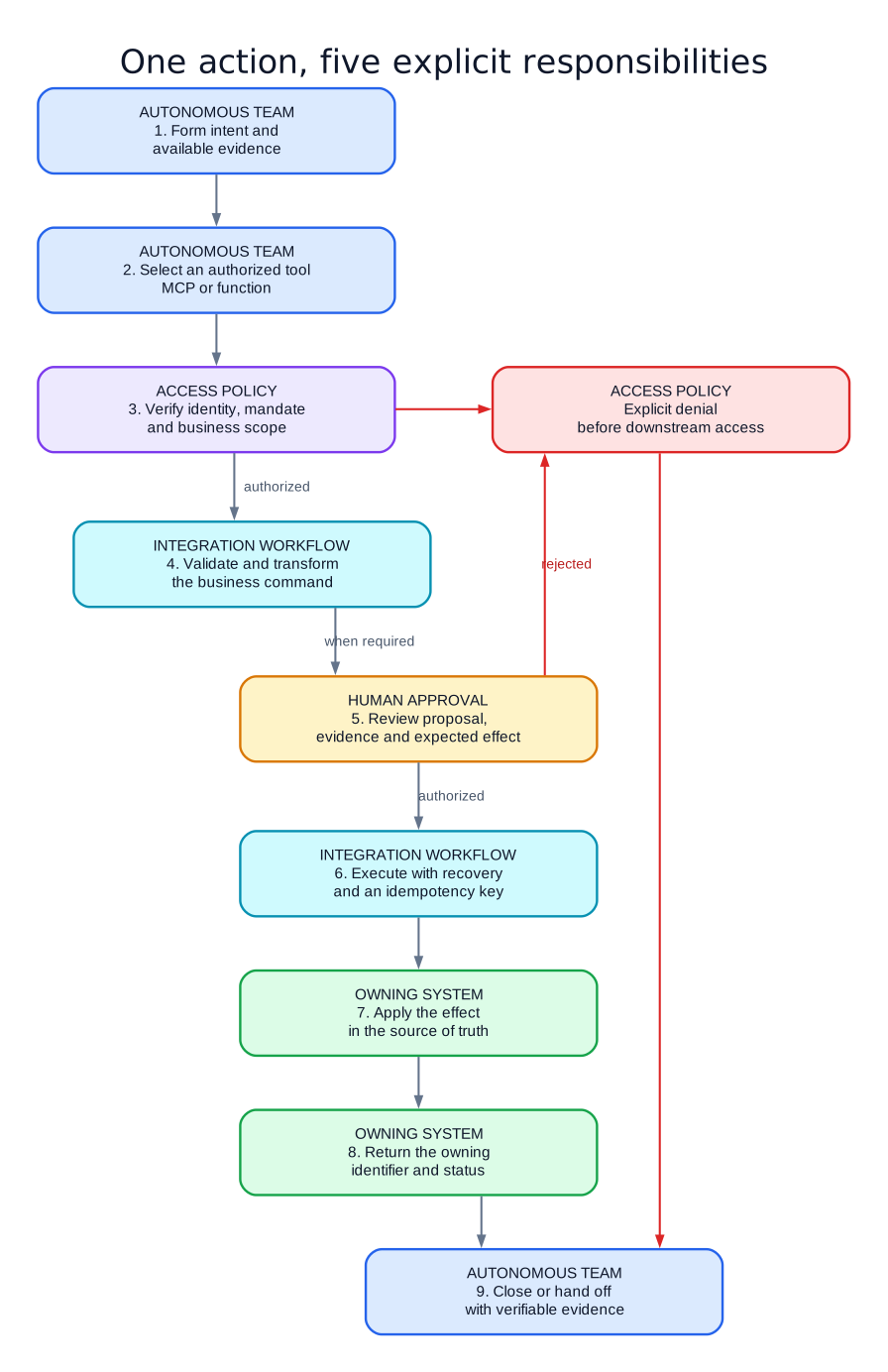
Atlensia diagram: MCP or a function tool carries the agent's intent, while authorization, recovery and effect confirmation remain assigned to identifiable components.
The sequence begins with structured intent, not technical credentials handed to the model. The policy layer connects the team's identity, role, relevant organization and requested operation. It can reduce the visible tool catalog before the model selects a tool. The OpenAI Agents SDK MCP documentation illustrates this principle through static or dynamic tool filters and approval policies, but these are implementation capabilities that must be configured, not automatic protection.
The workflow then receives a business command that can be made idempotent, meaning a retry does not create a second effect. It validates data, transforms formats and opens an approval when the consequence requires one. The owning system eventually performs the write and returns its own identifier. A “success” message produced by the model or connector is not sufficient. Confirmation must come from the system that actually owns the object.
Failure responsibility remains readable as well. A schema error returns to request preparation. A policy denial stops before downstream access. Temporary unavailability can be retried by the workflow without asking the model to invent a strategy. A business contradiction or rejected approval returns an explicit status to the autonomous team, which can request clarification or hand off the assembled case.
Keep three identities distinct
An agentic integration involves at least the identity of the person or process originating the request, the autonomous team's working identity and the technical identity presented to the target system. Collapsing them produces either excessive access or misleading traceability. The system should be able to state who requested, which autonomous role acted, which policy authorized and which account executed.
The June 18, 2025 MCP authorization specification requires protected HTTP servers to validate that tokens are intended for them. It also prohibits passing an inbound token unchanged to a downstream service because that behavior can create a confused-deputy problem. An MCP server calling a CRM or ERP should therefore use a separate downstream token scoped to that resource. The protocol supplies an authorization framework, but the enterprise still defines scopes, service accounts and the mapping between working identity and business rights.
This distinction prevents two shortcuts. The first is granting the MCP server an administrator account because it serves multiple tools. The second is reproducing the user's complete rights on every call even when the autonomous team's role is narrower. A sound policy calculates the intersection of mandate, context and operation. It does not automatically grant the broadest right available anywhere in the chain.
Choose by scenario, then combine without duplicating rules
For a support team retrieving an order status, a bounded read API may be enough. The function accepts an identifier, checks the customer's scope and returns a few fields. MCP becomes useful when the same capability should be shared by several assistants or when the catalog changes frequently. Adding a full workflow creates value only when retrieval then triggers steps, waits or coordination with other systems.
For a refund, the center of gravity changes. The decision depends on amount, reason, history and policy. The effect may require approval, several writes and compensation if one fails. The model can assemble evidence and propose an action through an MCP tool, but a workflow should control the transaction. The financial system API remains the final executor, and its identifier becomes the evidence.
For document research, the effect remains read-only and source variety dominates. MCP can provide a consistent interface to several repositories, with tools filtered by role. An integration platform is still useful if formats must be synchronized or events feed an index, but it is not required for every query. The best pattern follows the shape of the work rather than a uniform architecture rule.
Implementation should begin with one business effect. Write its contract independently of the channel: minimum input, preconditions, authority, approval, result, error, recovery and evidence. The team can then choose the agent-facing facade and execution engine. This method avoids implementing the same rules in an MCP description, a prompt, a workflow and an API. A critical rule should have one executable owner even when several layers observe and trace it.
Conclusion
Direct APIs, integration workflows and MCP are not three successive generations of the same technology. An API performs an operation, a workflow coordinates a process and MCP presents capabilities to models through a standard interface. The choice therefore depends on call stability, effect duration, the number of systems, recovery needs and how many agents must reuse the capability.
For Atlensia, the most robust combination often exposes a narrow business intent to the autonomous team, filters the tool according to its mandate and entrusts consequential transactions to a governed workflow. The owning system confirms the effect and supplies evidence. Before connecting another system, the useful next step is not selecting a protocol. It is writing the contract for the first business effect and assigning every control clearly.
Primary sources and references
Atlensia, Operating Layer and autonomous teams overview
Model Context Protocol, server primitives overview, June 18, 2025 revision
Model Context Protocol, tools specification, June 18, 2025 revision
Model Context Protocol, authorization specification, June 18, 2025 revision
OpenAI Agents SDK, MCP integration, tool filtering and approval documentation
Google Cloud, choosing Application Integration or Workflows, August 2026
Microsoft Learn, building custom Power Platform connectors