
Traceability becomes operational when every consequential action can be reconstructed without turning logs into an uncontrolled copy of enterprise data.
An autonomous team is not auditable merely because every conversation is retained. It is auditable when an authorized reviewer can reconstruct a consequential action: what triggered it, which mandate applied, which policies and sources were used, which tool was called, whether human approval was required, and what business effect actually occurred. This distinction matters. A complete transcript can remain difficult to investigate while creating new copies of personal data, trade secrets and internal instructions.
The better strategy is to log an evidence chain, not a stream of raw text. Structured metadata should be the default. Detailed content should be retained only when it is necessary to explain an exception, meet an applicable obligation or conduct an investigation, with redaction, access controls and retention limits. That approach fits the operating model described by Atlensia, where roles, permissions, policies, approvals and actions remain legible while business systems continue to own authoritative records.
A useful trace proves a sequence, not a conversation
When an agent prepares a response, retrieves a document and updates a CRM, three different layers are involved. The reasoning layer produces a proposal. The orchestration layer applies the role, permissions and approval rules. The business system records the official effect. A log that covers only the model call misses the moment when an intention becomes an action. A log that covers only the final write misses the mandate, evidence and controls that explain why the write was allowed.
An operational audit trail therefore connects events through a stable run identifier. It does not attempt to expose detailed internal reasoning. It links observable facts: the incoming request, team identity and configuration version, policy evaluation, source references, proposed tool call, any human decision, the system response and the final state. This model answers a precise operational question without forcing an investigator to reconstruct a timeline manually across several applications.
The following diagram shows that chain. The audit store is not a new system of record. It retains the identifiers, timestamps, versions, decisions and fingerprints needed to connect steps, while documents and business objects remain in their owning applications.
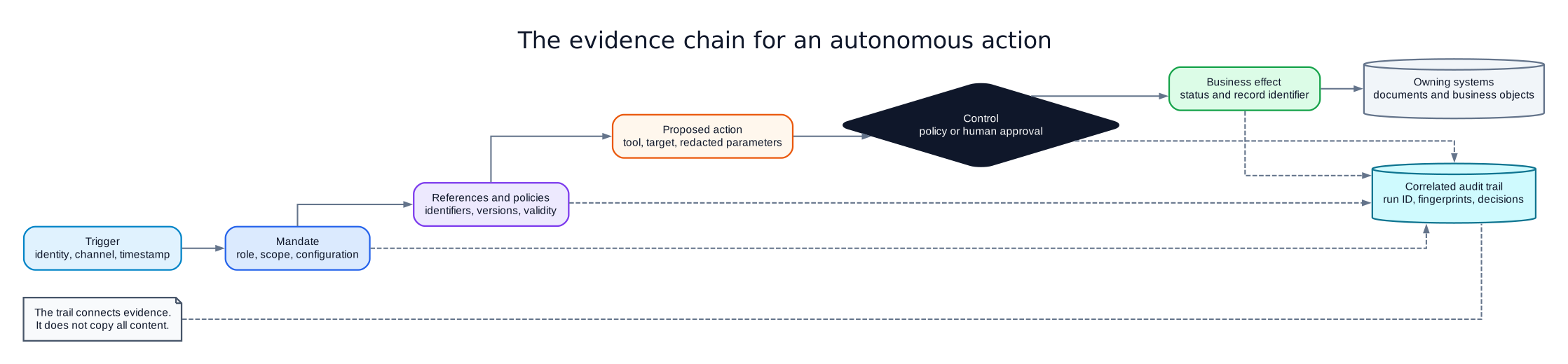
Atlensia diagram: an audit trail connects events through a run identifier instead of retaining a raw transcript of the entire session.
This separation changes incident diagnosis. A source failure, policy denial, missing approval and failed write are no longer grouped under the vague label of a bad AI response. Each failure has a distinct observation point, owner and corrective action.
Six events are often enough to reconstruct an action
The log should be designed around the questions that operations, security and internal control will actually need to answer. For an autonomous action that can modify a record, communicate externally or commit a workflow, six event families provide a useful foundation. They do not prescribe a particular product. They define the minimum continuity required between the original request and the final effect.
| Event | Minimum evidence | Question answered | Content to avoid by default |
|---|---|---|---|
| Trigger | identifier, channel, user or system, timestamp | Why did the run start? | full message when a reference is sufficient |
| Mandate | role, configuration version, scope, technical identities | Which team could act and with what rights? | secrets, tokens and credential values |
| References | source identifiers, version, validity date | Which facts supported the proposal? | complete copies of retrieved documents |
| Control | evaluated policy, result, coded reason, risk level | Which policy allowed, blocked or escalated the action? | sensitive internal instruction without a need |
| Action | tool, operation, target, redacted parameters, approval identifier | What was requested from the business system? | raw payload containing unrelated data |
| Outcome | status, business identifier, observed effect, error | What actually changed? | complete system response when status and reference are enough |
This grid prevents two common blind spots. The first is recording model output without recording the policy version or technical identity that enabled the action. The second is treating a successful tool call as proof of a business effect. An API may accept a request and fail later, create a duplicate or be compensated by another workflow. The trail must distinguish the request, technical acknowledgement and confirmed business state.
OpenTelemetry's semantic conventions for generative AI provide a useful vocabulary for correlating operations such as invoke_agent, execute_tool and retrieval. They also warn that messages, system instructions, retrieval queries, tool arguments and results may contain sensitive information. The goal is not to collect every available attribute. It is to use a stable, queryable schema while treating verbose content as optional data rather than a default collection policy.
Logging everything can make an investigation weaker
Full capture can feel reassuring during a pilot. It makes debugging easier while volume is low and users work with synthetic data. In production, the same choice creates a second information estate: prompts reproduce contract clauses, tool results expose customer files, system instructions describe internal controls and attachments may be copied into an observability store with weaker protections than the source application.
This risk is reflected in technical standards. OpenTelemetry marks several generative AI content fields as potentially sensitive and supports explicit opt-in treatment for attributes that are costly or risky. The principle also aligns with GDPR data minimization: personal data should be adequate, relevant and limited to what is necessary for the stated purpose. That does not mean content can never be retained. It means the evidentiary purpose must be defined before collection, not invented after an incident.
An overly detailed trail can also slow analysis. An incident team needs to filter by role, action, target, policy, approver, outcome and risk level. If these facts exist only inside unstructured text, searches become fragile. Volume increases while evidence remains difficult to aggregate. Structure must therefore come before content retention.
The log must also avoid becoming an indirect route to secrets that the autonomous team could not otherwise disclose. The least-privilege principles discussed in our article on securing autonomous team access apply equally to the storage and review of traces. An operator allowed to see run status should not automatically gain access to source data, sensitive parameters or sealed copies preserved for an investigation.
Three evidence levels avoid the choice between blindness and total surveillance
A workable policy does not choose between nothing and everything. It defines evidence levels. The normal level retains structured metadata, reference identifiers and fingerprints. The enhanced level adds redacted excerpts for an exception, sensitive operation or targeted quality review. The investigation level exceptionally retains a complete sealed copy in a separate environment with named access, a recorded justification and an expiry date.
The decision tree below selects the appropriate level for each event type. The first question remains operational: can the action be reconstructed? The second concerns sensitivity. The third requires a demonstrated need for the full payload. Debugging convenience alone is not enough to justify more intrusive retention.
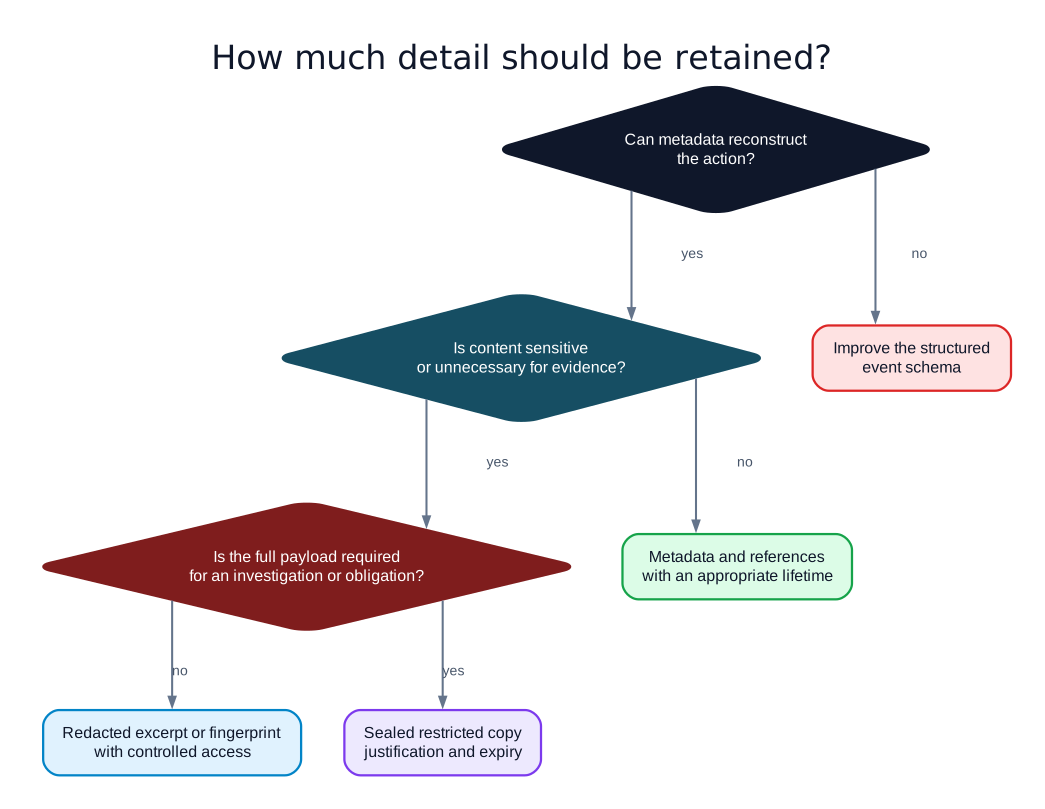
Atlensia diagram: recording depth depends on whether the action can be reconstructed, whether content is sensitive and whether a full payload is demonstrably necessary.
This model also supports different retention periods. Control identifiers attached to a financial operation may need to follow the business record policy. An excerpt used to diagnose an error may expire earlier. A complete copy created for an investigation needs an owner, purpose and deletion date. The correct lifetime follows purpose, applicable obligations and the process lifecycle, not the technical format of the log.
The business scenario reveals which evidence is necessary
Consider an illustrative procurement workflow. An autonomous team receives a supplier request by email, retrieves the purchasing file, evaluates a delegation rule and requests human approval before creating a commitment in the ERP. If the action is challenged, storing the complete email in the audit trail may not be necessary. The message identifier, attachment fingerprint, policy version, redacted amount or amount band, approver identity and ERP commitment identifier may be enough to reconstruct the sequence. The source file remains available in Outlook or the document system under its normal permissions.
The situation changes if the incident concerns a hidden instruction inside the attachment or an extraction error. A redacted copy of the relevant passage may then be necessary. If a formal investigation requires the original, it should be preserved in the organization's designated evidence system rather than silently duplicated across telemetry platforms. The policy should support this escalation in evidence level without forcing an emergency redesign of all instrumentation.
To frame an initial scope, the team can select three actions with visible business effects, such as sending an external message, changing a case status or creating a record. For each one, it writes the audit question, identifies the system of record, defines the six events, selects the evidence level and asks someone outside the deployment team to reconstruct the action. If that reviewer cannot explain the run from the trace and authorized references, the trail is incomplete. If the reviewer sees data unrelated to the audit question, the trail is too intrusive.
A trace proves neither source truth nor decision quality
Logging has limits that a governance architecture must acknowledge. A document identifier proves that a source was consulted, not that it was accurate or current. A successful policy result proves that a rule returned a decision, not that the rule was well designed. A human approval proves that a decision occurred, not that the approver had adequate context. The audit trail makes these elements reviewable. It does not make them true.
Technical integrity is another condition. Clocks need to be coherent, identifiers unique and critical events protected against modification. The OWASP Top 10 for Agentic Applications 2026 recommends comprehensive, immutable and signed audit logs for agent actions, tool calls and inter-agent communications in the relevant threat scenarios. That recommendation does not remove the need for content minimization. It reinforces the need to protect the evidence sequence and detect deletion, insertion or alteration.
The NIST Generative AI Profile also emphasizes documenting, recording and analyzing incidents, together with version history, metadata and responsibilities that help trace impact back to its source. For an autonomous team, that means connecting technical telemetry to the business change, policy register and incident process. Latency and token dashboards remain useful for operations, but they do not prove who could act, what was authorized or what changed.
The European Union AI Act additionally requires logging capabilities for high-risk AI systems covered by Article 12. This requirement does not automatically apply to every enterprise agent. It does reinforce a useful distinction: traceability should be proportionate to the intended purpose and support risk detection, operational monitoring and applicable oversight. Legal classification and retention duties should be established with the appropriate organizational functions.
Conclusion
Auditing an autonomous team does not require retaining everything it saw or produced. It requires the ability to reconstruct consequential actions through a run identifier, mandate, references, policy, tool call, approval and business effect. Structured metadata is the foundation. Redacted or complete content becomes a justified, protected and time-bound exception.
The useful next step is not to enable maximum logging. It is to select three high-impact actions, define the audit question for each one and test whether an independent reviewer can explain what happened without accessing more data than necessary. That is when traceability becomes a control mechanism rather than a technical accumulation.
Primary sources and references
Atlensia, autonomous team orchestration platform
OpenTelemetry, generative AI semantic convention attributes
OpenTelemetry, semantic conventions for events
NIST AI 600-1, Artificial Intelligence Risk Management Framework: Generative Artificial Intelligence Profile, July 2024
OWASP, Top 10 for Agentic Applications 2026
Regulation (EU) 2024/1689, Article 12 on logging for high-risk AI systems
General Data Protection Regulation, Article 5