
The right scope does not start from a job description or an AI capability list. It starts from a work unit, explicit decision rights and a reversible measurement loop.
An autonomous team should not be introduced from a list of tasks an AI model can perform. The right question is which unit of work can be delegated without obscuring the expected outcome, the right to decide, accountability for exceptions and the ability to roll back. Until those four elements fit together, the company has not redesigned work. It has only added a new interface to an existing process.
Task automation is enough when the input is recognizable, the output can be verified, the effect is reversible and an exception is easy to hand over. The role needs to be redesigned when the autonomous team changes several handoffs, accelerates a decision, combines activities that used to be separate or changes who owns residual risk. Keeping the job description unchanged in that situation creates a misleading organization: people remain formally accountable for work they can no longer fully see, while the system acts without a sufficiently precise operating mandate.
This distinction is central to Atlensia. An autonomous team is not simply an agent completing an action. It is a coordinated unit that pursues an outcome, uses tools within an authorized scope, retains evidence and knows when to request a human decision. Design therefore has to address both the software and the organization in which it operates.
Automating a task does not yet redesign a role
A task is a bounded transformation: reading a request, extracting fields, matching an identifier, preparing a response or updating a status. A role connects several tasks to an outcome, a set of tradeoffs and continuing accountability. Confusing the two leads the company to measure success at the wrong level. Accurate extraction does not prove that a request was handled correctly. A well-written message does not prove that the organization was allowed to make the commitment. A coherent recommendation does not prove that anyone knows who should challenge it.
The joint International Labour Organization and NASK report published in May 2025 uses task-level analysis rather than treating job titles as indivisible units. Its most useful conclusion for a company is not a ranking of occupations, but the finding that transformation is more likely than complete automation because many jobs combine activities with different exposure levels and still require human involvement. That changes the design problem. The goal is not to label a job as automatable, but to determine which tasks may change, which remain human and how their new combination reshapes the role.
The first decision should therefore be deliberately modest. If autonomy changes one stable step and the rest of the role remains coherent, automate that step and keep the organization readable. If it changes timing, available information, the order of activities or the place where a decision is made, treat the project as work redesign even if only a small number of tasks appear to be automated.
Start from the work unit, not the job description
A job description expresses broad responsibility. It is too wide to define a machine mandate and is often too old to capture workarounds, informal controls and actual handoffs. A work unit is more precise: it starts with an identifiable event, ends with an observable outcome and contains a limited set of decisions. A supplier request received and qualified, an incident routed to the right owner or a sales record enriched with evidence are work units. “Support operations” is not.
Finding that unit requires observing how work actually happens. Where do people search for missing information? Which cases require an opinion? Which checks prevent an irreversible loss? Which systems hold different versions of the truth? This observation often shows that the hard part is not text generation. It is identity, context, data freshness or the authority required to produce an effect.
The work unit then needs a simple operating contract. The input should be unambiguous, the outcome verifiable, approved tools named, prohibited data excluded and the stopping condition explicit. Atlensia can then coordinate the autonomous team around a concrete outcome rather than a sequence of prompts. The contract does not need to predict every path, but it must make deviations visible.
Map decision rights before tools
An automated process can be technically correct and still become organizationally dangerous if no one knows what it is allowed to decide. The NIST AI Risk Management Framework treats governance as a continuous, cross-cutting function. It calls for documented roles, responsibilities and communication lines, executive responsibility for deployment decisions and clear distinctions between human and system roles. Its appendix on human-AI interaction also notes that oversight requirements depend on context and that configurations can range from manual operation to autonomy.
The useful map asks more than “who approves?” It separates at least five rights: observe, recommend, decide, act and commit the company. An autonomous team may observe a case and recommend an action without being allowed to execute it. It may execute a reversible action without being allowed to create a contractual commitment. It may apply an approved rule while escalating cases in which identity, amount, risk or evidence falls outside the mandate.
This separation prevents two opposite failures. In the first, the system has powerful tools but a vague mandate, turning every apparent success into governance debt. In the second, every action requires human approval, preserving the cost of the process while adding an approval queue. The objective is not to put a human behind every click. It is to align authority with the consequence of the decision.
Four levels of change require four forms of governance
The decision is easier to structure by degree of work transformation than by model sophistication. As the autonomous team connects more steps and produces more effects, governance must move from a point control to a true operating model. The grid below helps select an initial level. It does not imply that every organization should progress toward the last row.
| Level | What changes | Example | Right delegated | Primary control | Signal that the role needs redesign |
|---|---|---|---|---|---|
| Assistance | A person receives a summary or proposal | Summarize a case before review | Observe and recommend | Verification by the person who acts | None if workflow and accountability stay stable |
| Delegated task | One stable step runs under known rules | Classify a request and prepare fields | Act on a bounded object | Rule validation and execution log | Low if the exception returns to the same owner |
| Bounded decision | The system chooses among preapproved options | Route an incident through a matrix | Decide within a threshold | Threshold, evidence and escalation | Present if the decision changes workload or priorities |
| Autonomous workflow | Several steps and tools are coordinated | Verify, enrich, route and update | Decide and act within a mandate | Identity, idempotency, limits and recovery | Strong because handoffs and timing change |
| Supervised service | The autonomous team owns a recurring outcome | Keep a request queue within service levels | Manage a work unit | Service objectives, sampling and incidents | Very strong because output is no longer produced task by task |
| Redesigned role | People and system divide outcomes and exceptions | The owner handles policy, sensitive cases and improvement | Human owns policy and residual risk | System-level performance review and withdrawal right | Role, skills and measures must be rewritten |
The table mainly prevents a language error. A workflow that reads several systems, chooses a path and produces an effect should not be described as mere assistance, even if a person can intervene afterward. Conversely, a suggestion feature does not necessarily transform a role. The vocabulary should follow the reality of decisions.
The work redesign cycle
Work redesign should not be a one-time workshop held before deployment. It operates as a loop that begins with real work, assigns decisions, tests a bounded mandate and uses results to modify the role or roll back. The diagram makes that loop visible and places expansion at the center as a conditional decision, never as the automatic next step after a pilot.
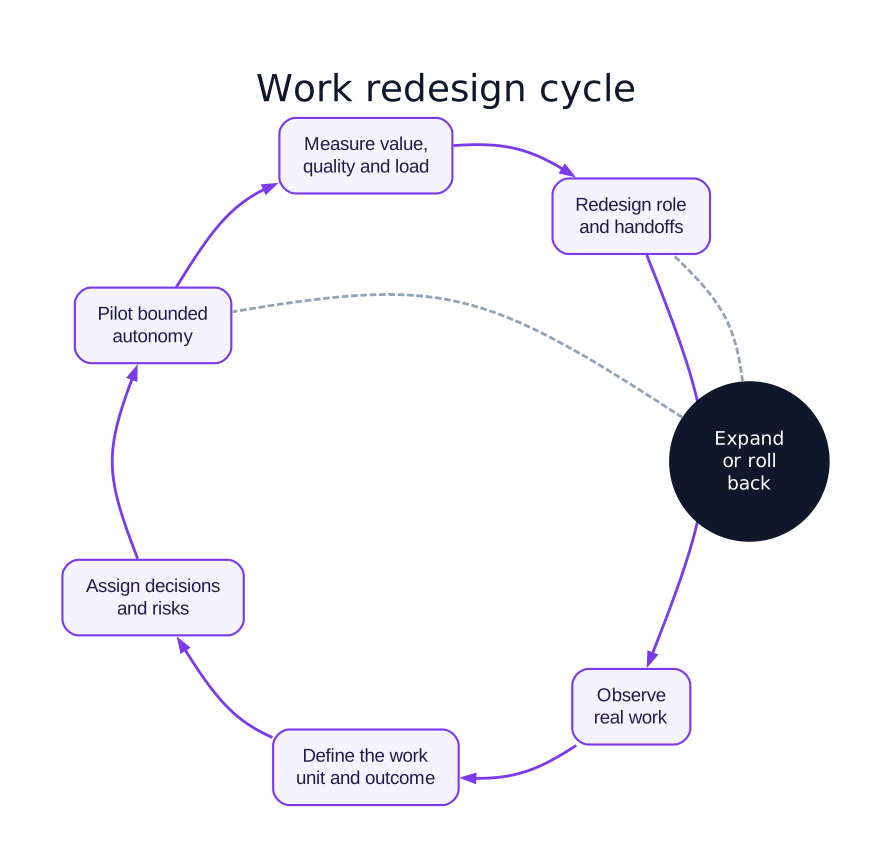
Atlensia diagram: work is observed, bounded and measured before the role is redesigned, then the scope expands or rolls back according to the evidence.
Observation reveals hidden dependencies. Defining the unit and outcome prevents the autonomous team from pursuing an abstract objective. Assigning decisions and risks turns an intention into a mandate. A bounded pilot exposes real cases without opening the whole system. Measurement compares quality, value, human load and incidents. Only then can the company redesign handoffs, skills and accountability.
Rollback has to be designed alongside autonomy. The NIST Manage function explicitly includes mechanisms and responsibilities for disengaging or deactivating a system whose outcomes are inconsistent with the intended use. In an operating model, that also means knowing who takes over the queue, which actions require reconciliation and how evidence from decisions made before shutdown will be preserved.
Humans should not become universal approvers
Human review is useful only when the person has enough time, information and authority to change the decision. Requiring approval after every action can look cautious while degrading attention. When proposals are numerous and almost always accepted, the control becomes ceremonial. The person learns to confirm the flow instead of finding the cases that need actual expertise.
A stronger allocation leaves policy choices, high-consequence exceptions, sensitive relationships and acceptance of residual risk with people. The autonomous team handles cases that fit the mandate, assembles evidence and explains why it stopped. The Operating Layer enforces rights, thresholds, budgets, logs and shutdown mechanisms. Human control then focuses on a valuable decision rather than repeating a machine step.
Handoff quality becomes a product in its own right. An escalation should not be a generic message asking someone to “check.” It should include the state reached, available evidence, uncertainty, the action that was not executed and the exact decision required. That structure reduces recovery cost and makes it possible to distinguish a business exception from a system defect.
Skills change with the role
Redesigning a role does not mean removing tasks and leaving everything else unchanged. The person must learn to express usable policy, recognize weak evidence, interpret traces, correct a decision and spot drift. They also need to understand the limits of the mandate without becoming a specialist in every model. Article 4 of the European AI Act, in the consolidated text applicable in 2026, requires providers and deployers to take measures to ensure a sufficient level of AI literacy among staff and other people operating or using AI systems on their behalf, taking account of experience, training and the context of use.
That literacy should be tied to actual work. General instruction about models does not prepare an operations owner to resolve an incomplete case. Useful training mirrors the role's decisions: which sources are authoritative, which deviations are acceptable, what evidence is mandatory, when to suspend the flow and whom to notify. The team also learns to report corrections so they become material for improvement rather than a series of invisible repairs.
The manager's role changes as well. The manager no longer allocates tasks only among people. They define outcomes, observe the actual division of work between people and systems, protect the capacity to escalate and decide whether the mandate should expand. This responsibility cannot be delegated entirely to a technical team because it shapes both work organization and service quality.
Measure the work system, not only the agent
An isolated success rate provides a poor description of a redesigned role. The organization needs to measure outcome quality, value, supervision load and risk control at the same time. An autonomous team may appear productive while shifting work into correction, context gathering or incident handling. Conversely, a high escalation rate can be healthy early on if it shows that the system recognizes the boundaries of its mandate.
Measurement should happen at the work-unit level. How many cases reach an acceptable outcome? What is the end-to-end delay between the triggering event and resolution? What share of cases requires human recovery, and how long does that take? Which actions were reversed or reconciled? Do exceptions cluster around a rule, a source or a particular segment? This view helps determine whether the problem comes from the model, the data, the policy or the role design.
Human indicators matter as much as technical metrics. If people lose their understanding of the process, no longer know how to correct an action or interruptions concentrate on a few experts, autonomy is creating fragility. A well-designed system reduces repetitive work without removing the knowledge required to take over.
Choose the level for the scenario
For highly variable, relational or politically sensitive work, assistance and recommendation are often the best starting point. The autonomous team prepares context, compares options and retains sources, while the person makes the decision. The value comes from reducing research, not transferring authority.
For high volumes of standardized cases, a delegated task or bounded decision may be more appropriate. The mandate then depends on testable criteria, a reversible action and an available exception owner. The company should resist adding adjacent steps immediately. Every new tool increases the error surface and can turn local automation into an implicit role redesign.
In a workflow that crosses several systems, redesign is difficult to avoid. The system changes handoffs, processing time and what people can see. The project must then include the future human role, skills, measures, recovery and management accountability. Without that work, the organization retains nominal responsibilities that no longer match actual control.
Expand by capability, with rollback
The safest expansion does not simply send more volume through the same mandate. It adds an identifiable capability, such as a new source, a write permission or one additional decision, and then reassesses the consequences. Each capability needs its own test, limit, trace and withdrawal mechanism. This structure makes change understandable to the business and simplifies incident analysis.
An expansion review should compare outcomes with the initial assumptions, examine exceptions and confirm that the role owner still accepts the allocation of responsibilities. If control load rises, errors become difficult to detect or people lose an essential skill, the right decision may be to reduce autonomy. Rollback is not a program failure. It is a normal function of a governed system.
Conclusion
The choice between automating a task and redesigning a role is not primarily determined by model power. It depends on the change produced in decisions, handoffs, accountability and recovery. A stable, verifiable and reversible task can be delegated without disrupting the organization. A workflow that changes authority or the expected outcome requires a new operating model.
For Atlensia, the robust path is to define a work unit, make decision rights explicit, pilot bounded autonomy, measure the complete system and redesign the role from evidence. The company is then neither trying to preserve every gesture nor attempting to automate a job title. It is building a division of work in which autonomous teams produce a controlled outcome and people retain the authority, skills and means to take over.
Sources
NIST, Artificial Intelligence Risk Management Framework, Core, January 2023
NIST, AI RMF Appendix C: AI Risk Management and Human-AI Interaction, January 2023
European Union, Artificial Intelligence Act, Article 4, consolidated text dated July 27, 2026