
The most robust design fixes the process states and permissions, then gives the model measured freedom only where interpretation creates real value.
Most enterprise processes should be neither fully deterministic nor handed without limits to a planning agent. The most robust design fixes the process states, permissions and exit criteria, then lets the model choose an approach only where the context genuinely varies. This bounded autonomy preserves adaptability without making the outcome, cost or recovery path impossible to predict.
The distinction matters for Atlensia. An autonomous team receives a role, scope, tools and rules, but that mandate does not mean it should improvise every business transition. An agent may interpret a request, search for evidence or propose an order of operations. The system must still determine when the context is sufficient, which action is authorized, when a person must approve and how a failure returns to a controlled state.
Autonomy is not a property of the entire process
The words “workflow” and “agent” can make two incompatible product categories appear to exist. They are better understood as two ways to orchestrate work. In a deterministic workflow, code fixes the sequence of steps. In a model-led system, the model chooses the next step from the objective, its observations and the tools available. Anthropic draws a similar distinction between workflows with predefined code paths and agents that dynamically direct their tool use. The OpenAI Agents SDK orchestration documentation likewise contrasts orchestration in code, which is predictable in behavior, speed and cost, with orchestration entrusted to a model.
This difference does not need to be settled once for the entire application. One process can receive a request through a fixed route, use a model to classify it, call sources according to an adaptive plan, require deterministic approval above a threshold and execute an action through a strictly typed connector. The autonomy level then becomes a local decision attached to each state, not a slogan applied to the whole team.
It is also a product decision. The more freely a model can choose its steps, the more variation the system can handle without every path being coded in advance. That flexibility also expands the set of trajectories that must be tested, increases the spread of latency and cost, and makes it harder to explain why two similar requests followed different paths. The useful question is therefore not “do we want an agent?” but “where does the value of planning exceed the cost of additional control?”
Three control modes instead of a binary choice
Three modes cover most situations. A deterministic workflow is appropriate when inputs and transitions are known. Bounded planning is appropriate when the path varies but the admissible states, tools and stopping conditions can be defined. Open planning becomes reasonable only when the objective cannot be decomposed in advance, the environment provides reliable feedback and effects remain reversible or subject to approval.
| Decision criterion | Deterministic workflow | Bounded planning | Open planning |
|---|---|---|---|
| Request variability | Low and known | Medium to high within a defined domain | High and difficult to anticipate |
| Next step | Fixed in code | Chosen from authorized transitions | Proposed dynamically by the model |
| Available tools | Fixed list for each step | Subset tied to the current state | Broader set, still governed |
| Consequence of error | May be high when controls are explicit | Low to medium, or approval before high impact | Low, reversible or consistently approved |
| Cost predictability | High | Measurable through step and budget limits | Lower, requiring strict caps |
| Evaluation | Nominal cases and known branches | Trajectories, transitions and stopping criteria | Outcome, behavior and resistance to drift |
| Recovery | Recovery point encoded in the workflow | Return to a safe state or escalate | Stop, contain and hand off to a person |
This table does not describe a maturity hierarchy. A fixed workflow is not an unfinished agent. In a financial close, the order of controls, segregation of duties and period lock have business value of their own. By contrast, preparing a market brief requires selecting queries, judging document relevance and filling gaps that never appear in exactly the same form. Quality comes from matching the control mode to the shape of the work.
Bound planning with a state machine
A state machine makes this compromise explicit. It does more than describe the happy path. It defines the information required to leave a state, the permissions available within it and the destination when a condition is not met. The model may develop a plan to complete the context, but it cannot declare on its own that a sensitive action has been approved.
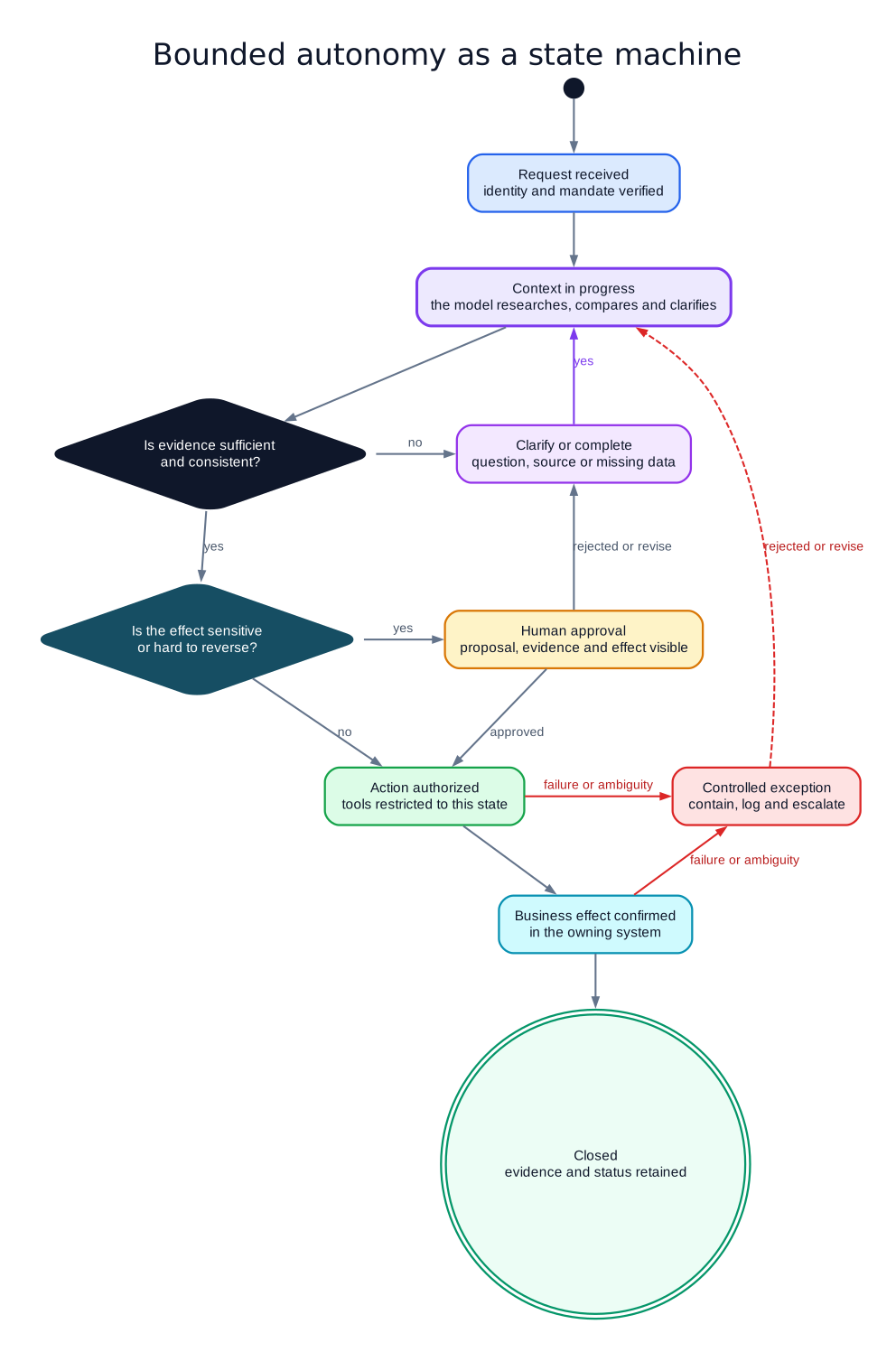
Atlensia diagram: the model may plan within an authorized state, while the process retains explicit transitions, approval thresholds and a recovery path.
In this design, the “context in progress” state is deliberately flexible. The agent may inspect several authorized sources, compare information or request clarification. The transition to “ready to decide” remains conditional on identifiable evidence, acceptable freshness and the absence of an unresolved contradiction. When those conditions are not met, the correct behavior is not to guess but to continue gathering or ask a person.
Human approval should not be a button added at the end either. It is a transition in which the reviewer can see the proposal, supporting evidence, expected effect and alternatives. NIST emphasizes clearly defined human roles, responsibilities and oversight across different human-AI configurations. In an enterprise agent product, that becomes a simple rule: approval is meaningful only when it concerns a comprehensible decision and when its result actually changes execution rights.
The business effect should determine the mode
Consider supplier onboarding. Checking for required documents, querying a designated registry and creating a record after approval can follow a deterministic workflow. The obligations are known and the order of controls matters. Interpreting an activity described in inconsistent formats, matching a legal name across conflicting documents and drafting questions about missing evidence benefit from bounded planning. The agent chooses how to establish context, but it changes neither the eligibility rules nor the approval threshold.
For competitive intelligence, the balance is reversed. The way sources are found and cross-checked must adapt to the topic. More open planning may be useful while the agent works in read-only mode, cites its sources and publishes nothing without review. The transition to external distribution remains deterministic: claim verification, editorial review, channel selection and final approval. Autonomy is high during exploration and much lower when the company commits its reputation.
In internal support, the distinction often falls between information and transaction. Finding a procedure and proposing an answer allow bounded exploration. Changing an access right, canceling an order or modifying payroll data require verified identity, explicit scope and sometimes a second approval. Two requests written in the same conversation may therefore pass through different autonomy regimes. The type of effect, not the conversational appearance, should determine control.
Test the trajectory, not only the answer
An evaluation focused on the final answer misses an essential part of the risk. An agent may reach a correct conclusion after querying an unauthorized source, bypassing an approval step or consuming ten times the expected budget. Conversely, a justified stop when evidence is insufficient may be the best result. Evaluation should therefore cover the path taken, tools called, transitions requested, stopping criteria and the business effect actually observed.
For a deterministic workflow, tests naturally cover each branch, connector failures and idempotent recovery. For bounded planning, scenario sets should also vary missing documents, contradictions, source unavailability and attempts to cross a permission boundary. For more open planning, evaluation must further measure goal stability, step count, cost, the ability to recognize a dead end and behavior when a tool returns an ambiguous result.
Anthropic's research on trustworthy agents describes an agent as a plan, act, observe and adjust loop operating across several layers that include the model, harness, tools and environment. This view is a reminder that an error is not always a bad generation. It may result from an overly broad permission, incomplete tool feedback or an environment that cannot confirm an effect. Testing the trajectory assigns the problem to the right layer, making it possible to fix something other than the prompt when necessary.
Design the minimum sufficient autonomy
The starting point is to describe the acceptable business effect before choosing the orchestration. Identify the object being changed, the person or system that owns it, the method for confirming the result and the cost of reversal. A read-only, reversible and readily verifiable action supports more exploration than an external write that is difficult to correct. This classification sets a limit on planning before the model is even discussed.
Next, identify where real cases diverge. If variation consists of a few stable branches, code remains easier to understand and less costly. If inputs are heterogeneous but the target state can be specified, bounded planning becomes useful. It should receive a step budget, restricted tools, evidence criteria and structured output. Google describes its sequential, parallel and loop workflow agents as predefined and predictable orchestrators, illustrating the value of simple primitives even within an agentic application.
Finally, design recovery before the first deployment. Every state should answer three questions: what do we know, what may the agent do now and where does the request go if that action fails? Safe recovery may be an idempotent retry, a return to evidence gathering, a hold state or an escalation with the assembled case. Without that path, planning does not create operational autonomy. It merely sends exceptions to people who must reconstruct the context after the fact.
Conclusion
The best system is not the one that lets the model make the most decisions. It is the one that places each decision at the right level. Stable sequences, permissions, thresholds and sensitive effects benefit from remaining deterministic. Interpretation, research and adaptation to variable input can be entrusted to an agent within a bounded space. Open planning remains a targeted choice for exploratory goals with reversible effects and a genuine ability to stop.
For Atlensia, this approach turns the scope of an autonomous team into an executable mechanism. The role defines the mission, states structure the work, tools delimit action and approvals protect consequential transitions. Autonomy is no longer measured by the number of improvised decisions, but by the ability to make useful progress without leaving an explicit mandate.
Primary sources
Atlensia, autonomous teams and governance overview
Anthropic, “Building effective agents,” December 19, 2024
Anthropic, “Trustworthy agents in practice,” April 9, 2026
OpenAI Agents SDK, multi-agent orchestration documentation
Google Agent Development Kit, workflow agents documentation
NIST, “Artificial Intelligence Risk Management Framework 1.0,” January 2023