
The right model is not a universal winner. It is a governed resource inside a measurable and replaceable system of work.
When an organisation designs an autonomous team, it often begins with a seemingly sensible question: which model is best? That framing creates the wrong architecture decision. It turns a fast-changing component into the foundation of the system, even though success depends first on the work being delegated, the tools that may be used, the decision rules and the way outcomes will be reviewed.
Providers now offer several model tiers themselves. OpenAI distinguishes configurations for capability, balance and efficiency. Anthropic positions different families around complexity, speed and cost. Google and Mistral also organise their catalogues around distinct operating profiles. This does not mean every company should adopt several providers. It shows that no model is optimal for every task handled by the same autonomous team.
For Atlensia, the useful question is therefore different: which policy assigns the right level of model to each piece of work while preserving the same roles, permissions, approvals and evidence? A public leaderboard or context-window figure cannot answer it. The answer belongs in the operating layer, where the business objective is separated from the engine producing a proposed decision or action.
The model is not the autonomous team
A model produces a response or requests a tool call. It does not hold a legitimate enterprise mandate by itself. Even when a provider uses the language of agents or tool use, execution depends on an application that exposes tools, validates arguments, applies permissions and handles the result. Anthropic's tool-use documentation describes this contract directly: the model emits a structured request, then the application or service executes the operation. This separation is essential because it prevents reasoning capability from being confused with authority to act.
The Atlensia operating layer places the model inside a wider system of work. A role defines the mission. Policy determines which data and tools are available. Approvals protect sensitive effects. Records make the decision reconstructable. In this architecture, changing a model should not change the business contract, just as changing a search engine should not redefine the accountability of a legal or commercial team.
The same distinction protects the organisation from a subtler form of lock-in. A prompt can accumulate model-specific assumptions, implicit formats, workarounds for defects and tool descriptions shaped around one provider's syntax. After a few months, the workflow appears portable in an architecture diagram but is not portable in practice. The dependency lives in behavioural detail, not only in the API endpoint.
The object to govern is therefore not “the company model”. It is a versioned configuration connecting a task category to a model, reasoning level, tool set, data policy, acceptance thresholds and fallback route. That configuration can evolve without rewriting the autonomous team's mandate.
Three architectures create three kinds of risk
An organisation can operate one general-purpose model, several models from one family or a router that can move work between providers. These are not three maturity levels. They address different constraints and move risk between simplicity, cost, continuity and governance.
| Architecture | Main advantage | Structural risk | Coherent situation |
|---|---|---|---|
| One general-purpose model | Fewer variants to integrate and supervise | Excess cost on simple tasks and behavioural dependency | A narrow first pilot with limited volume and uniform requirements |
| One model family | A more consistent provider and tool contract | Variants still require separate evaluation | Several levels of complexity in one cloud environment |
| Multi-provider routing | Continuity, specialisation and negotiating leverage | More complex policy, data, records and tests | Significant volume, regional constraints or a measured resilience need |
A single model is often the right starting point, but seldom the right permanent target. It reduces the number of variables while the team learns to define tools and success criteria. Its weakness appears when every task, including simple classification and structured extraction, pays the cost and latency of a model selected for the hardest cases. The organisation then funds unused capability without improving the accepted outcome.
A model family introduces routing without changing the main commercial contract. Current OpenAI, Anthropic, Google and Mistral catalogues all illustrate this portfolio logic. The operational value comes less from model names than from reserving the highest capability for ambiguous cases while moving stable volume to a more efficient configuration. Evaluation is still required: variants from the same family can differ in tool selection, schema adherence and the way uncertainty is reported.
Multi-provider routing becomes relevant when service continuity, data location, a particular modality or a measured cost-quality ratio justifies the added complexity. It requires the organisation to normalise tool schemas, errors, limits and records. Without that layer, routing does not remove dependency. It distributes dependency across several integrations that are difficult to compare.
Provider catalogues offer candidates, not a ranking
As of 18 August 2026, official documentation shows portfolios built around several trade-offs. OpenAI presents GPT-5.6 Sol for complex work, Terra for balancing intelligence and cost, and Luna for volume-sensitive workloads. Anthropic distinguishes Claude Fable 5 and Opus 5 for demanding work, Sonnet 5 for intelligence at scale and Haiku 4.5 for speed. Google positions Gemini 3.5 Flash for sustained agentic work, Gemini 3.6 Flash around speed-intelligence balance and Flash-Lite for throughput. Mistral also offers general-purpose models at different sizes alongside specialist models.
| Provider | High-capability starting point in official documentation | Balance or efficiency starting point | What the organisation still has to prove |
|---|---|---|---|
| OpenAI | GPT-5.6 Sol | GPT-5.6 Terra and Luna | Quality on private tasks, total cost and tool behaviour |
| Anthropic | Claude Fable 5 or Opus 5, depending on the work | Claude Sonnet 5 and Haiku 4.5 | Measured value of the higher tier, latency and platform availability |
| Gemini 3.5 Flash for sustained work | Gemini 3.6 Flash and Flash-Lite | Version stability, multimodal quality and project quotas | |
| Mistral | Mistral Large 3 | Medium 3.1, Small 3.2 or Ministral 3 | Useful specialisation, deployment option and operating cost |
This table does not claim performance equivalence across providers. The labels come from vendor documentation and will change. They help select candidates for testing, not declare a winner. A model described as more capable can still be less reliable with a poorly documented internal tool. A smaller model can perform better on closed classification because the task rewards stability rather than extended deliberation.
Version names also need to be governed as dependencies. Google distinguishes stable, preview, latest and experimental versions, each with different update behaviour. Anthropic documents pinned model identifiers for recent generations. Convenience aliases accelerate experimentation, but a production autonomous team needs a verifiable identifier, validation date and migration procedure. Otherwise, behaviour can change without an explicit organisational decision.
Evaluation must reproduce the work, tools and refusals
Comparing answers to a handful of general questions mostly measures demonstration quality. An autonomous team needs an evaluation set drawn from its real workflow, with the same documents, tools, permissions and output schema expected in production. Difficult cases are not limited to tasks requiring more reasoning. They include missing information, conflicting sources, unavailable tools, out-of-mandate requests and actions that must be refused.
The comparison unit is the accepted business result, not the price per million tokens. A cheaper model may cause more retries, tool calls and human repair. A more expensive model may remove those steps, without necessarily compensating for its latency. The evaluation must therefore measure the complete trajectory from intake to acceptance or escalation.
| Measure | Decision question |
|---|---|
| Task success | Did the result move the case forward under the business criterion? |
| Correct tool call | Was the right tool selected with valid and authorised arguments? |
| Refusal and escalation | Did the model stop when evidence or authority was missing? |
| Human correction | How much work remained before acceptance? |
| End-to-end latency | Did the workflow remain timely, including at the 95th percentile? |
| Cost per accepted result | What did models, tools, retries, records and supervision cost together? |
| Stability | Did results remain acceptable across repeated runs and versions? |
Providers offer execution mechanisms such as OpenAI Evals, the Claude evaluation tool and Vertex AI evaluation services. These can speed up testing, but the definition of success belongs to the organisation. The NIST AI Risk Management Framework places measurement inside a broader process of mapping, governance and risk treatment. An average score cannot replace analysis of severe failures.
A router is useful only when its decision is explainable
A router should not ask one model to select another model freely from a vague instruction. It should apply an observable policy to attributes that have already been qualified: task type, data sensitivity, external effect, complexity, modality, deadline, budget and required evidence. Some attributes come from the workflow and others from a controlled classifier. Every one of them should be recoverable from the activity record.
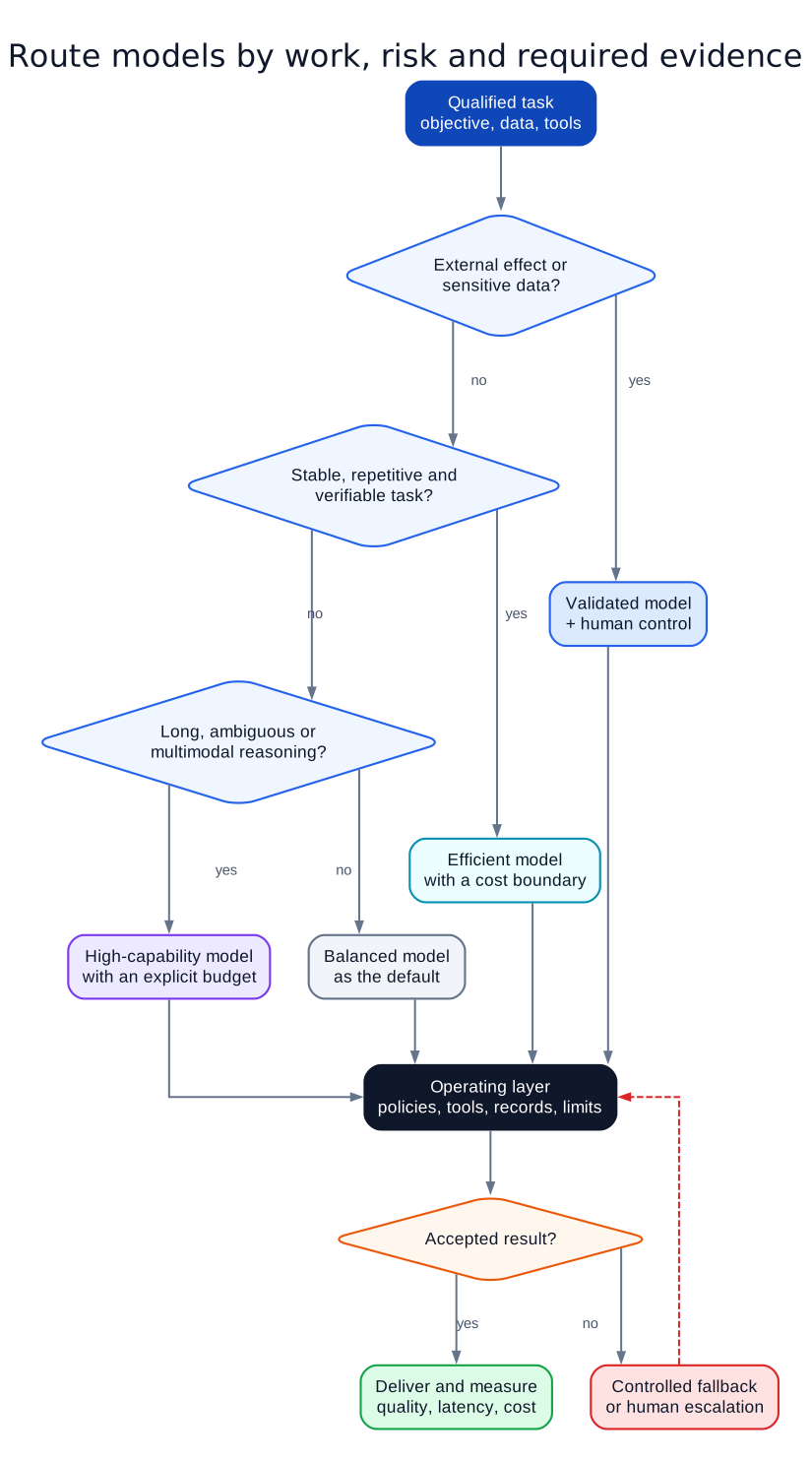
Atlensia diagram: the model is selected after the work is qualified, then governed by the operating layer's policies, tools, limits and records.
The diagram highlights an important rule: risk does not automatically select the most powerful model. It first selects the level of control. Work that commits the organisation or handles sensitive data needs a validated configuration and, where the impact requires it, a human decision. Model capability removes neither authorisation nor accountability.
Fallback is also a business decision. Silently calling a second model after a failure can double cost, transmit data to another provider or produce competing actions. The fallback route must state what can be retried, with which provider, after which error and under what limit. For an external action, failure should often lead to escalation instead of an automatic second attempt.
The operating layer should make the model replaceable
An architecture aligned with Atlensia keeps the mandate, tools and rules outside provider configuration. A model registry connects a pinned identifier to a validation date, approved regions, supported modalities, data-processing conditions, context limits, available tools and the evaluation set it passed. The registry does not merely record what is technically accessible. It records what is authorised for a specific role and workflow.
Tool schemas then provide a stable interface. A purchase-order tool, for example, retains the same business fields and validations regardless of the model requesting it. An adapter may translate the provider's technical format, but it does not change policy. This separation makes tests comparable and prevents a model change from quietly expanding the action scope.
Context follows the same principle. Role instructions, decision rules and business references are versioned independently from the model. Provider-specific optimisations are isolated in an adapter and documented as such. During migration, the team can change one factor, run the same evaluation set and identify the source of a regression.
Finally, the activity record connects every result to the configuration actually used: model, version, reasoning level, exposed tools, routing policy, consulted sources, approvals and fallback route. Without that evidence, an organisation can observe that a result changed without knowing whether the cause was the model, prompt, document, tool or policy.
Turn model selection into an architecture decision
The first comparison should be narrow enough to produce a conclusion. Select a real workflow with stable volume and a meaningful set of exceptions. Preserve the role definition and tools, then compare three configurations: a simple reference, a more efficient variant and a higher-capability variant. The goal is not to test the entire market. It is to find where an increase in capability materially improves an accepted outcome.
Run the configurations first on historical cases or synthetic cases validated by subject-matter experts. Move next to observation on live work without enabling external effects. The most useful differences will not always be wrong answers. They are often unnecessary tool calls, missing refusals, unsupported conclusions or cases that should have escalated earlier.
The final decision can remain simple. Keep one model if quality is consistent and volume does not justify a router. Introduce a model family when stable work supports a more efficient variant without degrading refusals or tool behaviour. Add a second provider only when a measured requirement for resilience, data location or specialisation covers the operating cost of the new dependency.
Conclusion
An autonomous team does not become robust because it uses the newest or most capable model. It becomes robust when the organisation can explain why a task received a particular configuration, which boundaries applied and what evidence authorised the outcome. The model remains important, but it is one governed resource inside a delegation architecture.
A single model is a sound baseline for a narrow scope. A model family becomes useful when task volume and diversity reveal measurable trade-offs. Multi-provider routing is justified only by a real continuity, location or specialisation requirement. In every case, the decision should come from the same test cases and business criteria.
For Atlensia, the purpose of the operating layer is precisely to preserve this separation. Roles, permissions, tools, approvals and records should not be redesigned whenever a provider releases a new model. External stability allows internal capability to evolve without turning each model update into an organisational transformation project.
The next step is not to choose a winner from a public comparison. It is to select one workflow, pin three candidate configurations and measure accepted outcomes, refusals, tool calls, latency and total cost. Routing comes after that evidence, not before it.
Primary sources and references