
Good oversight does not put a person behind every click. It defines what the autonomous team may execute, what should be sampled and what requires a decision before effect.
Requiring human approval for every action taken by an autonomous team does not automatically create a safer system. It can slow the workflow, move accountability into an approval queue and encourage routine confirmation. Removing all review because a system performed well in testing creates the opposite problem: the company accepts effects it may never have observed. The right design unit is therefore not “human or no human.” It is the level of authority granted for a particular action.
A robust policy distinguishes at least five levels: direct execution, execution followed by sampling, exception stop, approval before effect, and dual control or prohibition. Moving from one level to the next depends on business consequence, reversibility, evidence quality, case novelty and the legal or financial authority being exercised. Model capability matters, but it never replaces this operating analysis.
For Atlensia, the policy connects the autonomous team's role, tool access, handoff rules and traceability. It should not be hidden in a prompt or reduced to a confidence threshold emitted by the model. It needs to become a readable contract among the business owner, process owner, security function and people responsible for oversight.
Approval is useful only when it can change the action
An approve button provides no control if the reviewer does not understand the proposal, cannot see the supporting evidence or lacks authority to modify it. The UK Information Commissioner's Office describes meaningful human review as review by people with enough knowledge, experience, authority and independence to challenge a decision. Its operational framework also recommends manageable caseloads, appropriate training and logs of decisions that challenge or override automated outcomes.
Those conditions separate effective control from a ceremonial gesture. If a request arrives without verified identity, source, explanation of the applied policy or a precise statement of the decision required, the reviewer has to reconstruct the case. If hundreds of similar items arrive under an unrealistic deadline, confirmation becomes the path of least resistance. If the person can only accept or reject and cannot correct the action, the organization loses information needed to improve the system.
Approval should therefore be designed as a decision with its own contract. Its input contains evidence, uncertainty and the proposed effect. Its output is approval, modification, rejection or a request for more information. The author and rationale are retained. The expected response time fits the business process. Without those elements, a human is present in the interface but absent from governance.
Start with the effect, not the task
Two technically similar actions can require different controls. Drafting an internal email and drafting a contractual response use the same generation capability but exercise different authority. Updating a CRM tag and changing a supplier's bank details are both writes, yet their impact and reversibility are not comparable. Policy must classify the effect produced, not merely the tool invoked.
The effect is defined by what changes in the company's world. Is data created, disclosed or deleted? Is access granted? Is a payment, commitment or deadline triggered? Can an external party rely on the result? Can the action be fully reversed, quickly and without secondary consequences? These questions form a more stable basis than a probability declared by a model.
Evidence strength completes the analysis. An action based on an explicit rule, confirmed identity and current system-of-record data can receive more autonomy than one based on approximate matching or an unverified document. Novelty matters too. A case that follows an evaluated path is not equivalent to a combination of data, tool and context that has never been tested.
Turn risk tolerance into an enforceable rule
The NIST AI Risk Management Framework 1.0, published in 2023 and under revision in 2026, calls on organizations to tailor risk-management activity to their risk tolerance. It also calls for documented roles, responsibilities, system knowledge limits and human oversight processes. The framework does not supply a universal threshold. It requires context and accountability to be explicit.
An enforceable approval rule answers four questions. Which condition raises the control level? Which evidence allows the action to remain at its current level? Who holds authority to approve the effect? What happens when review does not arrive on time? These answers must be evaluated before the tool call because approval requested after an irreversible action is no longer a barrier. It is a record of what already happened.
In an Atlensia design, the Operating Layer can carry this separation between intent and authority: the autonomous team prepares an action, policy evaluates its attributes, the appropriate control level is applied, and the effect and supporting evidence are traced. This is a design model, not a claim that one rule fits every process. Each company must connect policy to its systems of record, delegations and obligations.
Five control levels instead of a binary switch
The following ladder represents increasing authority controls. It does not classify a workflow once and forever. The same workflow may execute ordinary cases directly, stop exceptions and prohibit one particular action. The level belongs to an action in context, not to the agent's name or to the entire team.
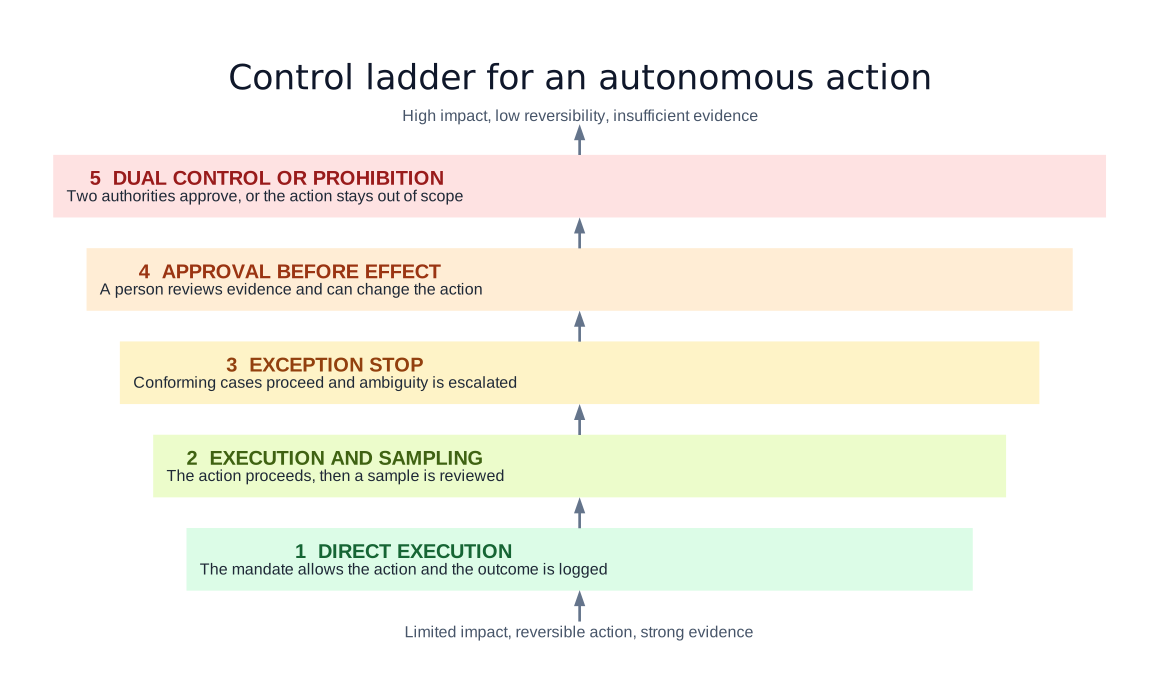
Atlensia diagram: the control level rises as the effect becomes more consequential, less reversible or less supported by available evidence.
The first level suits limited, reversible and well-instrumented effects. The second replaces individual approval with statistical or targeted review to detect drift without blocking every case. The third lets cases inside the mandate proceed and suspends those crossing an ambiguity threshold. The fourth requires a human decision before any effect. The fifth adds separation of duties or keeps the action outside the autonomous mandate.
This ladder avoids confusing control with friction. Adding approval everywhere can reduce oversight quality by spreading attention too thinly. Sampling, however, is appropriate only when errors are detectable afterward and their consequences remain recoverable. A high-impact action does not become acceptable simply because its average error rate is low.
A decision grid for classifying each action
Policy becomes more consistent when every action is evaluated against the same dimensions. The grid below offers a starting point. The examples are illustrative and must be adapted to the organization's delegations, systems and regulatory requirements.
| Situation | Potential impact | Reversibility | Available evidence | Suggested level | Additional control |
|---|---|---|---|---|---|
| Add a non-decision internal label | Limited | High | Identified rule and source | Direct execution | Log and correction path |
| Enrich a record with public data | Limited to moderate | High | Dated source and confirmed identity | Execute then sample | Track corrections and staleness |
| Route a request to an internal queue | Moderate | High | Tested criteria with possible ambiguity | Exception stop | Ambiguity threshold and human recovery |
| Send a preapproved external message | Moderate to high | Low after sending | Identity, consent and template validated | Approval or tightly bounded mandate | Frequency limits and complete log |
| Change an access right | High | Variable | Verified request and owner | Approval before effect | Separate requester, approver and executor |
| Change bank data or initiate payment | Very high | Low | Multiple independent sources | Dual control or out of scope | Out-of-band verification and financial limit |
The “suggested level” column is not a legal rule. It demonstrates the reasoning. An organization may require stronger control because of internal policy, sector, jurisdiction or affected people. It may also automate more when reversibility, limits and detection mechanisms have been demonstrated. The important requirement is to document the rationale and test it under realistic conditions.
Model confidence is not enough
A confidence score can inform a rule, but it measures neither impact nor authority. Depending on the technique, the score may represent a calibrated probability, similarity, margin between classes or a textual self-assessment. Those values are not interchangeable. They can also degrade when data, context or tools change.
The meta-analysis published in October 2024 by Michelle Vaccaro, Abdullah Almaatouq and Thomas Malone examined 106 experiments and 370 effect sizes comparing humans alone, AI alone and their combination. On average, human-AI systems performed worse than the better of humans or AI alone, with losses particularly apparent in decision tasks. The authors report substantial heterogeneity across studies and do not conclude that no collaboration works. Their finding instead shows that adding a human to an output, or displaying an explanation, does not guarantee better performance.
Approval policy should therefore combine several signals: evidence quality, conformity to the expected path, consequence, reversibility, novelty and the observed performance of the human-system combination. If a model score triggers review, it should be calibrated for the use case, monitored in production and paired with a fallback. One number should never carry the entire authority decision.
Protect human attention through sampling
Sampling is appropriate for repetitive actions whose errors are observable, correctable and limited in consequence. It preserves attention for cases requiring judgment while producing a continuous measure. The sample should not be designed for comfort. It needs to cover rare segments, new sources, model changes, anomalies and periods of degrading performance.
The NIST AI RMF Playbook recommends documenting the degree of oversight, operator overrides, errors or complaints, response times and adjudication activity. Those measures assess the control system as well as the AI system. An approval rate near 100 percent may mean the system is excellent. It may also mean that presented cases are too easy, reviewers lack time or they have no real alternative.
Sampling needs an escalation rule. If a segment exceeds error tolerance, corrections concentrate on one cause or review cannot happen within the expected time, the action temporarily moves to a stricter level. When evidence shows sustained improvement, the level may move down. Oversight becomes an adaptive system rather than a fixed formality.
Build a review packet that can actually be reviewed
The approver should not need to read the autonomous team's entire history. The packet should present the objective, proposed action, affected object, sources used, triggered policy, uncertainties, expected effect and rollback option. It should also state what has not been executed. That last point prevents a proposal from being mistaken for an action already underway.
The view should show relevant alternatives. If the real choice is to send, wait or transfer to another role, the interface should not reduce the decision to yes or no. The reviewer needs to correct a data point, select another path or request more evidence. Those corrections should be logged without automatically becoming training data because a human decision may also be wrong or unique to an exceptional case.
Available time is part of the control. Sensitive approval with an unrealistic deadline creates pressure toward acceptance. An undefined queue blocks the process and invites workarounds. The review contract therefore names an owner, response time, backup and behavior when no decision arrives. For an important action, expiration should stop the action rather than imply approval.
Legal requirements are a targeted floor, not a universal policy
Article 14 of the European Artificial Intelligence Act, adopted in 2024, applies to high-risk AI systems. It requires human oversight measures to be proportionate to risk, autonomy and context of use. Assigned people must be able, as appropriate, to understand relevant capabilities and limitations, monitor anomalies, remain aware of automation bias, interpret outputs, disregard or reverse an output and interrupt the system in a safe state.
Those provisions do not establish that every autonomous team falls within the high-risk regime. Classification depends on the use and applicable legal framework. They do provide a sound design principle: oversight can be effective only when the person has the necessary competence, information and authority, and the system allows genuine intervention.
Uses outside that scope still need internal policy. Security, data protection, employment, finance or internal-control obligations may impose other gates. The process owner should have those requirements validated by competent legal and compliance functions rather than infer a universal rule from one article of law.
Test the control as a system component
Before production, testing whether the autonomous team asks for approval at the right time is not enough. The organization must verify that the reviewer receives the right information, understands the decision, detects an incorrect case and can intervene before the effect. Deliberately ambiguous scenarios, conflicting evidence and reviewer unavailability reveal how the control behaves in practice.
In production, four measures are especially useful: trigger frequency by segment, time to decision, the share of proposals modified or rejected, and incidents that should have caused stricter control. These measures must be read together. Fast decisions and no rejections do not prove effectiveness. Rising rejection may indicate better attention, system drift or a policy that has become too permissive.
Periodic review must also inspect actions never shown to a person. If policy looks only at escalated cases, it cannot detect incorrect routing into direct execution. Samples from each level, compared with business outcomes and incidents, make the oversight mechanism testable.
Conclusion
Human approval is neither a universal safety net nor friction that should always be removed. It is an authority mechanism that must be calibrated for each action. As an effect becomes more consequential, harder to reverse, more novel or less supported by evidence, control should move before execution and involve someone who can genuinely challenge the proposal.
The next step is to inventory the actions an autonomous team can produce and assign each one a control level, minimum evidence, owner, response time and fallback. Atlensia can then coordinate autonomy around an explicit mandate: ordinary cases advance, exceptions stop at the right point and human attention remains available for decisions where it supplies real judgment and authority.
Primary sources and references
NIST, Artificial Intelligence Risk Management Framework 1.0, January 2023. The framework connects governance, mapping, measurement and risk treatment.
NIST, AI RMF Playbook, Measure function, under revision in 2026
European Union, Regulation 2024/1689 on artificial intelligence, Article 14, June 13, 2024
Information Commissioner's Office, AI audit framework, Human review, guidance under review in 2026