
Autonomy can expand from intake through exception preparation, while approval, accounting entry and payment remain separated until controls are demonstrated.
An autonomous team can create value in invoice processing long before it receives permission to post entries or release payments. Its first scope should turn every invoice into a verifiable case: structured data, an identified supplier, purchasing references, explained discrepancies and an assigned next decision. Approval and payment remain separated until the organization has demonstrated control reliability, recovery quality and traceability of effects.
This boundary avoids two opposite mistakes. The first limits AI to extracting a few fields from a PDF without addressing the real accounts payable workload. The second treats plausible extraction as an authorized transaction and grants ERP or banking access too early. A more useful operating role lies between them: prepare a complete decision, process conforming cases within bounded rules and hand off exceptions without hiding uncertainty.
An invoice is a claim supported by evidence
An invoice does not become payable because its number, amount and date were read correctly. It asserts that a supplier delivered goods or services under agreed terms to an entity that must verify its obligation. The decision therefore depends on other objects: supplier master data, purchase order, order lines, receipt, contract, cost center, tax rules, duplicate history and approval authority.
Structured formats reduce part of the ambiguity without resolving that decision. The European Commission describes EN 16931 as a semantic model defining electronic invoice business terms and rules for consistent interpretation. It explains that structured messages can be validated automatically against those specifications. A new EN 16931-1 version was published in May 2026, and the Commission states that migration from the 2017 version still has to be organized by relevant authorities. A deployment should therefore verify the applicable version in each jurisdiction instead of embedding a regulatory assumption in a prompt.
Structure gives the autonomous team an essential advantage: it can distinguish a received value from an inferred value. A supplier identifier present in a UBL message does not have the same status as one inferred from a logo or partial address. The OASIS UBL 2.3 specification also connects invoices to earlier objects such as orders, dispatch advice and receipt advice. Matching is therefore reasoning over a chain of business records, not merely document reading.
Decide scope one stage at a time
The right unit of delegation is not “process an invoice.” Each stage has a different evidence source, error type and consequence. An autonomous team can act more freely on reversible classification than on an accounting entry, even when both operations appear in the same conversation or interface.
| Stage | Useful autonomous team work | Exit evidence | Recommended initial authority |
|---|---|---|---|
| Intake | Identify channel, format, entity and attachment | Timestamped input object and fingerprint | Automatic execution |
| Reading | Extract terms while retaining provenance | Structured values linked to their source | Automatic with thresholds |
| Validation | Test schema, required fields and arithmetic | Versioned rule results | Deterministic execution |
| Identification | Match the supplier without changing master data | Candidate, identifier and evidence level | Proposal or strict rule |
| Matching | Compare invoice, order, receipt and contract | Line-level discrepancies and linked records | Bounded read-only action |
| Exception | Classify the cause and assemble the case | Reason, owner and precise question | Autonomous preparation |
| Approval | Present the decision and record authority | Signed decision or applicable policy | Person or separate policy |
| Posting | Create the entry with a unique reference | ERP identifier and confirmed status | Governed workflow |
| Payment | Release funds under mandate and due date | Bank identifier and reconciliation | Separate role, outside initial scope |
This table shows why one automation rate can be misleading. A team may automate almost all preparation while retaining human approval for a small number of high-consequence stages. Conversely, calling an invoice “processed” because its fields were extracted ignores the research, discrepancies and decisions that consume the operations team's time.
Start with the exception case
The best first product is often not the happy path, which conventional rules already handle well. It is the exception case. When an invoice does not match its order, the autonomous team can identify the affected lines, check whether a receipt is missing, find the purchase owner and formulate a precise question. It reduces reconstruction effort without making the financial decision for its owner.
This design requires provenance. Every consequential amount should link to the document or system that supplied it. A calculation rule should identify its version. An assumption, such as a probable match between two supplier names, must remain marked as an assumption. The case then becomes usable by an approver who can verify the reasoning without rereading the entire inbox.
The following lifecycle is illustrative and does not claim an announced Atlensia feature. It shows how autonomy can remain broad during intake and preparation, then narrow as an action creates an accounting or financial effect.
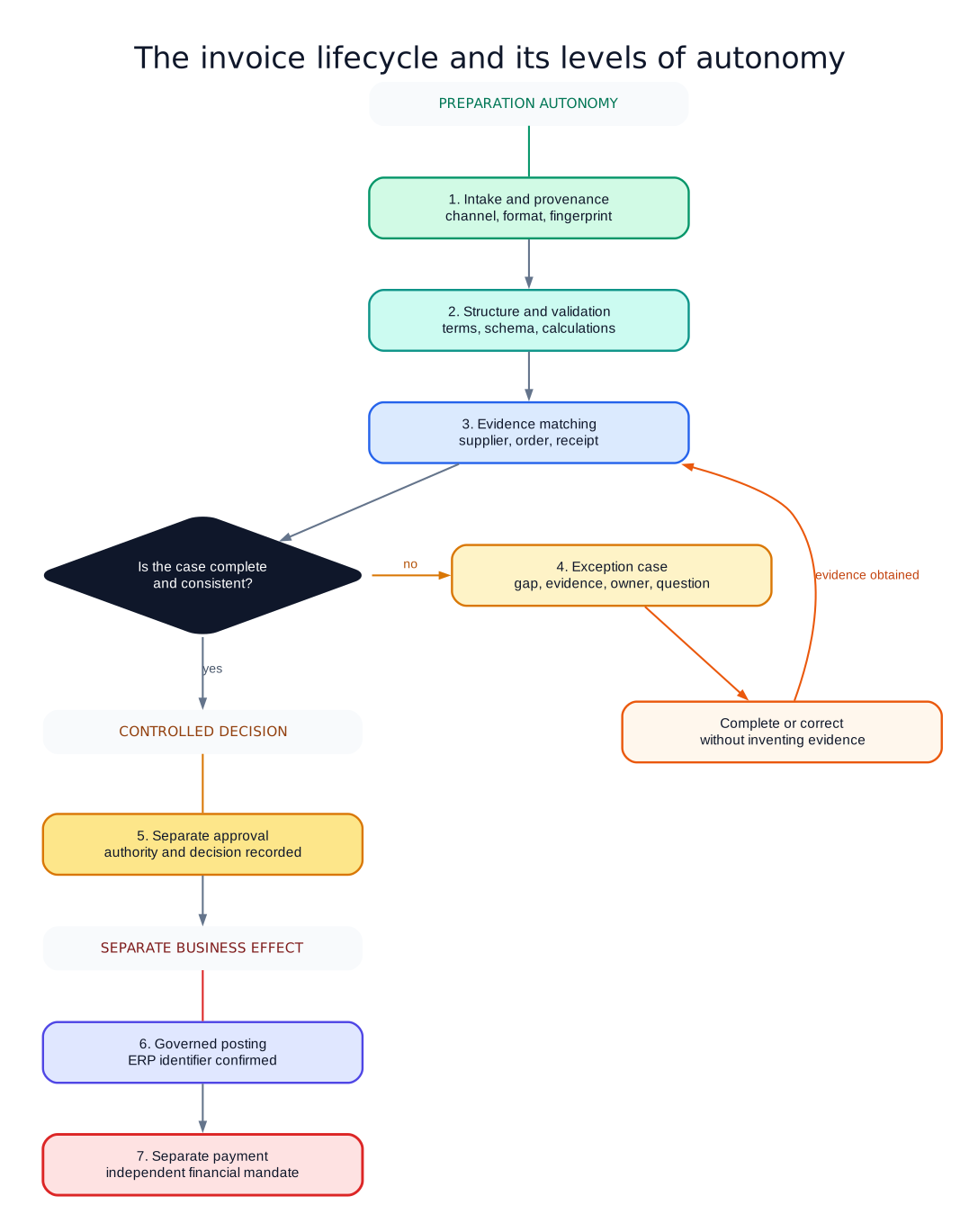
Atlensia diagram: the autonomous team prepares and qualifies the decision, while every move toward posting or payment depends on distinct evidence and authority.
The exception loop is central. If an order reference is missing, the supplier is uncertain or totals are inconsistent, the process should not force the invoice into generic approval. It returns to evidence gathering or assigns the case to the appropriate role. This exit path reveals system maturity better than the speed with which simple cases pass.
Structured rules should precede interpretation
The May 2026 Peppol BIS Billing 3.0 rules include deterministic requirements for an invoice number, date, type, currency and party identification. They also cover references that connect an invoice to a purchase order and order lines. A model should neither replace these controls nor reinterpret a fatal rule as optional guidance.
The autonomous team operates around the rules. It can explain a rejection in the operator's language, search for missing evidence or recognize that two descriptions probably refer to the same service. It may also choose the order of searches according to context. Schema validation, total calculations, code lists and authorization thresholds are better kept in versioned, testable components.
This separation prevents false equivalence. If an invoice fails a Peppol rule, the case contains a message compliance problem. If it passes the schema but does not match the receipt, it contains a business exception. If order and receipt match but the supplier is blocked, it contains a master-data or risk decision. Each cause has a different owner and should not be collapsed into a vague “low confidence” state.
Approval, posting and payment are three decisions
Approval generally confirms that spending is legitimate within a given scope. Posting translates that decision into accounts and an accounting period. Payment releases funds. Combining all three acts into one agent tool may simplify a demonstration, but it removes useful barriers. Separation should remain visible in identities, permissions, audit records and recovery points.
The U.S. Government Accountability Office's 2025 Green Book applies to federal agencies, not as a universal rule for every enterprise. It remains a useful primary source on internal control principles: management designs preventive and detective control activities according to risk, including risks involving improper payments, and considers segregation of duties. A company's exact requirements come from its accounting framework, policies, auditors and jurisdiction.
An autonomous team may therefore prepare an approval without being the approver. It may start a posting workflow without holding general write permission. It may monitor due dates and flag delays without the ability to release payment. This architecture follows the method in our article on choosing among APIs, workflows and MCP: agent intent remains narrow while the consequential effect belongs to a governed component.
Adjust autonomy to the invoice type
An invoice linked to a complete order and receipt offers the most bounded path. The system can compare identifiers, quantities, prices, taxes and tolerances against known rules. If all controls pass, a workflow may prepare or perform posting under internal policy. The model contributes little to the core decision but can explain results and handle wording variation.
An invoice without a prior purchase order requires more context. A subscription, consulting engagement or property expense may depend on a contract, service period and budget owner. The autonomous team can retrieve those elements and prepare the approval chain, but it must not invent receipt evidence because the amount resembles the previous month. Recurrence is an indicator, not authority.
A credit note or corrected invoice should be connected to the object it changes. OASIS UBL distinguishes invoices, credit notes, debit notes and remittance advice within a broader process. Good processing preserves those relationships instead of treating every document as a new isolated request. An autonomous team can locate the origin and calculate the proposed difference while the ERP confirms the final allocation.
Bank detail changes need a separate route. An invoice alone is not sufficient evidence for modifying supplier master data. The request should be verified through a channel and role authorized by company policy. Even a fully matched invoice must not change sensitive data without a separate control.
Measure reliability before expanding rights
Operating metrics should distinguish preparation quality from effect quality. For preparation, an organization can track the share of consequential fields linked to a source, correctness of exception reasons, cases returned for missing information and the time an approver needs to understand the case. These measures should come from a reviewed sample and a stable definition, not a model estimate.
For effects, monitor duplicates, allocation errors, recovery events, bypassed approvals and discrepancies between announced status and ERP status. A run identifier should connect input, controls, decision and entry without unnecessarily copying all sensitive data. Our method for auditing an agent without logging everything describes that evidence chain.
Rights can expand with evidence. A team starts in read and preparation mode, then triggers workflows for a subset of fully matched invoices. Automatic posting is considered only when errors are detectable, recovery is idempotent and independent controls remain active. Payment is a separate decision that may never be delegated even when preceding stages become highly reliable.
Conclusion
The right first scope for an autonomous accounts payable team is not payment. It is building a case in which every value, rule, discrepancy and decision can be verified. Structured formats and deterministic validations handle what must be exact. The agent interprets variation, searches for evidence and prepares exceptions. Finance roles retain decisions whose consequence requires separate authority.
The next step is to select one invoice type and map its real evidence: order, receipt, contract, supplier, tax rule, approval and ERP identifier. Once that chain is defined, Atlensia can organize the autonomous team's role, tools, limits and handoffs around a measurable effect without confusing operational assistance with the power to pay.
Primary sources and references
Atlensia, Operating Layer and autonomous teams overview
European Commission, compliance with the EN 16931 eInvoicing standard, updated March 6, 2026
European Commission, eInvoicing standards and specifications, updated June 24, 2026
European Commission, EN 16931 validation artifacts, updated February 2, 2026
OpenPeppol, Peppol BIS Billing 3.0 rules, May 2026 release
OASIS, Universal Business Language 2.3, June 15, 2021
U.S. Government Accountability Office, 2025 Green Book, effective fiscal year 2026
NIST, Generative AI Profile for the AI Risk Management Framework, July 2024